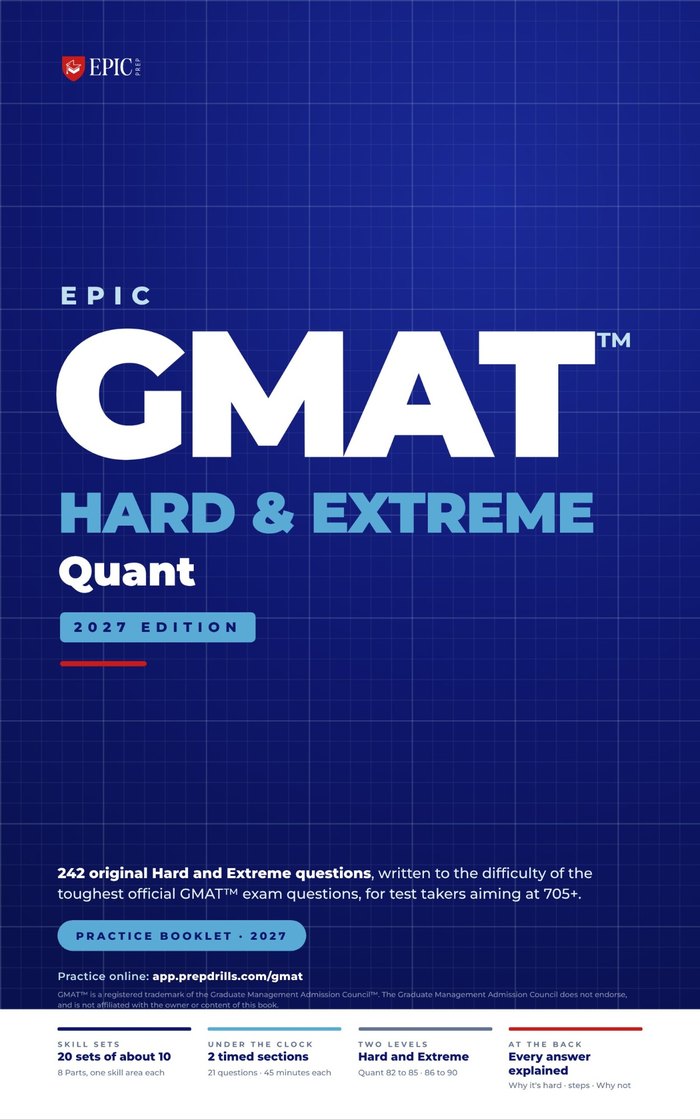
EPIC GMAT Hard & Extreme Quant 242 original practice questions for the GMAT Focus Quantitative section, with step-by-step explanations and timed sections, for test takers aiming at 705+.
Every question is Hard or Extreme, and the difficulty comes from insight, not arithmetic. The numbers stay friendly; the idea is what you have to find. Work 20 sets of 10 on the clock across 8 skill Parts, then take 2 timed sections of 21 questions in 45 minutes. No calculator, as on test day.
Paperback and Kindle on Amazon · By Jaclyn Caruana, MBA · 2027 Edition, published November 6, 2026, by Epic Education, SLU · Paperback, 128 pages, 8.5 x 11 in · ISBN 979-8140462802
2027 Edition
242Original Quant questions
20Timed sets of 10
2 × 21Timed sections, 45 minutes each
705+The score it is built for
Hard GMAT Quant practice, the Epic way
Already solid on the basics? This is the practice that is left.
The book opens with six instructions, and the whole book is built around them. Here they are, in short.
“A wrong answer on an Extreme question is normal; a wrong answer you cannot explain afterward is the one to fix.”
From How to use this booklet
1
Who this is for
Test takers aiming for 705+ who are already solid on the basics. Every question is Hard or Extreme.
2
Know the two levels
Each question carries a level pill: HARD for a Quant section score of 82 to 85, EXTREME for 86 to 90.
3
Work each set on the clock
Each set header shows a target time. Start a timer, do all 10 without stopping, then note your time next to the target.
4
No calculator
Quant has no calculator on test day, so neither does the book. Every question falls to a cleaner idea, not longer arithmetic.
5
Then go Under the clock
2 timed sections of 21 questions, 45 minutes each, mixing every Part, with no level pills, as on test day.
6
Review every miss
Read the Why it's hard line first, then redo the question cold. Count a guess as a miss.
More than one move, or one move the question hides: a second phase in a rate problem, a cap that limits the freed capacity, a hidden case.
Extreme86 to 90Quant section score
Insight or structure: a constraint to notice, two rules that interact, a base that switches halfway through. In the book's words, a wrong answer here is normal; a wrong answer you cannot explain is the one to fix.
Hard GMAT Quant practice questions
Try three questions from the book
One Hard and two Extreme questions from three different Parts, exactly as printed. Set a timer, solve each one without a calculator, then reveal the book's answer, its Why it's hard line, the steps and the EPIC tip.
Part 4 · Set 10 · Q4Hard
Printers A and B share one network line that carries at most 40 pages per minute in total. While both printers are printing, the line is split evenly between them; a printer printing alone gets the whole line, except that no printer can print faster than 25 pages per minute. At 9:00 a.m., A starts a 300-page job and B starts a 500-page job. How many minutes after 9:00 a.m. does B finish?
A15
B20
C23
D25
E32
Answer: C
Why it's hard: Two phases plus a cap: the rate changes when the first job ends, and the freed capacity is limited by the per-printer cap, not by the line.
While both print, each gets \(\frac{40}{2} = 20\) pages per minute.
A finishes its 300 pages after \(\frac{300}{20} = 15\) minutes. By then B has printed \(20 \times 15 = 300\) of its 500 pages.
Now B prints alone. The line could give it 40 pages per minute, but the cap holds it to 25.
B's last 200 pages take \(\frac{200}{25} = 8\) minutes.
B finishes \(15 + 8 = 23\) minutes after 9:00 a.m.
💡 EPIC tip: when jobs share a capacity, rates change at the moment a job ends. Find that moment first, then recompute the survivor's rate, and check every cap before you use the freed capacity.
Why not B: Lets B use the whole 40 pages per minute once A is done \(\left(15 + \frac{200}{40}\right)\), ignoring the cap.
Question code HQ4-S1-04
Part 5 · Set 13 · Q8Extreme
At a company, the average (arithmetic mean) salary of the men was 1.5 times the average salary of the women. This year, with no change in the number of men or the number of women, the men's average salary rose by 10%, the women's average salary rose by 20%, and the company's total payroll rose by 14%. What is the ratio of the number of men to the number of women at the company?
A4:9
B2:3
C1:1
D3:2
E9:4
Answer: C
Why it's hard: Hidden base switch: the seesaw weights are payroll dollars, so the head-count ratio needs a second step through the salary ratio.
The 14% rise in the total payroll is a weighted average of 10% and 20%, weighted by each group's share of the payroll, not by head count.
14 is 4 above 10 and 6 below 20, so the payroll split is men : women \(= 6 : 4 = 3 : 2\).
Payroll is head count times average salary. With a woman's average \(s\) and a man's \(1.5s\): \(\frac{M \times 1.5s}{W \times s} = \frac{3}{2}\).
So \(1.5 \times \frac{M}{W} = 1.5\), and \(\frac{M}{W} = 1\). Answer: 1:1.
💡 EPIC tip: a percent change in a total is weighted by the dollar amounts, not by the people. Find the dollar split first, then divide each side by its per-person amount to get head counts.
Why not D: Reads the payroll split, 3:2, as the head-count ratio.
Question code HQ5-S2-08
Part 6 · Set 14 · Q7Extreme
Five married couples, each made up of one man and one woman, sit in a row of 10 seats. Each couple must sit in two adjacent seats, and along the whole row, men and women must alternate. How many seating arrangements are possible?
A120
B240
C3,840
D14,400
E28,800
Answer: B
Why it's hard: Interacting constraints: alternation forces every couple block into the same orientation.
The person in seat 1 has only seat 2 next to them, so seats 1 and 2 hold a couple. Then seats 3 and 4 hold a couple, and so on: the couples fill the seat pairs 1 and 2, 3 and 4, 5 and 6, 7 and 8, 9 and 10.
Order the 5 couples in these 5 seat pairs: \(5! = 120\).
Seat 1 holds a man or a woman: 2 choices. Alternation then fixes the gender of every seat.
With every seat's gender fixed, each couple has exactly 1 way to sit in its pair, not 2.
Total: \(120 \times 2 = 240\).
💡 EPIC tip: When two rules overlap, see what one forces on the other. Alternation fixes every couple's orientation at once, so the \(2^5\) you expect collapses to 2.
Why not C: Uses \(5! \times 2^5\), letting each couple flip freely and ignoring alternation.
Question code HQ6-S1-07
Questions, answers, Why it's hard lines, steps and EPIC tips from EPIC GMAT Hard & Extreme Quant, Sets 10, 13 and 14. In the book, every explanation also has a Why not line for each wrong choice; one is shown here for each question.
GMAT Quant explanations
Every answer explains the move, and every wrong choice
Answers and Explanations start with an answer key for each Part. Then every question gets the same four parts, so a miss turns into a move you can use on the next question.
Why it's hard
The move, named
One line that names what makes the question hard: a hidden case, a second phase, a base that switches.
Steps
One per line
The full solution, one step per line, with the arithmetic and the cases shown, not just the rule named.
💡 EPIC tip
The move to reuse
The transferable idea, written for the next question of the same kind, never a restatement of the answer.
Why not
Each wrong choice
The error that produces each wrong answer, so you can tell which trap you fell into.
Each question also has a code, such as HQ4-S1-04. Think you found an error? The book asks you to email hello@prepdrills.com with the code; every report is checked, and corrections go into the next printing.
Look inside
Real pages from the book
The contents: 8 skill Parts with 20 sets, Part 9 Under the clock, and the answers.Part 4 opens with Set 10, Rates and work: level pills and a target time of 29:00.An answers page from Part 5: Why it's hard, the steps, the EPIC tip and a Why not line for each wrong choice.
PDFFREE
Free sample
Try all 30 questions of Part 2, free
Part 2 of the book, Number Properties and Divisibility, exactly as printed: three timed sets of 10. Work each set on the clock; the answers and explanations are in the book.
Set 4, Primes and factors, LCM/GCF and factor counts: target time 27:15
Set 5, Divisibility and remainders: target time 28:50
Set 6, Number properties and factor counts: target time 26:40
Every question labeled Hard or Extreme, as in the book
One skill area per Part. Each set has 10 questions and a target time, the sum of Epic's target times for its questions. Page numbers are the book's own.
Part 1 Exponents and roots
3 sets · 30 questions · 6 more in Under the clock · p. 6, answers p. 53
Set 1 · Units digits and remainders of huge powers27:00 · p. 6
Set 2 · Large powers, digits and decimals27:00 · p. 7
Set 3 · Exponent algebra, radicals and nested roots27:00 · p. 8
Part 2 Number properties and divisibility
3 sets · 30 questions · 6 more in Under the clock · p. 10, answers p. 61
Set 4 · Primes and factors, LCM/GCF and factor counts27:15 · p. 10
Set 5 · Divisibility and remainders28:50 · p. 12
Set 6 · Number properties and factor counts26:40 · p. 14
Part 3 Percents, profit and ratios
3 sets · 30 questions · 6 more in Under the clock · p. 16, answers p. 70
Set 7 · Percents23:00 · p. 16
Set 8 · Profit/cost/revenue and interest & finance23:35 · p. 18
Set 9 · Ratios & proportions22:40 · p. 20
Part 4 Rates, work and mixtures
2 sets · 20 questions · 5 more in Under the clock · p. 22, answers p. 80
Set 10 · Rates and work29:00 · p. 22
Set 11 · Mixtures and algebraic word problems29:00 · p. 24
Part 5 Statistics and overlapping sets
2 sets · 20 questions · 5 more in Under the clock · p. 26, answers p. 86
Set 12 · Statistics28:10 · p. 26
Set 13 · Weighted averages, overlapping sets and overlapping sets with averages27:00 · p. 28
Part 6 Combinatorics and probability
3 sets · 30 questions · 6 more in Under the clock · p. 30, answers p. 93
Set 14 · Combinatorics25:00 · p. 30
Set 15 · Probability24:00 · p. 32
Set 16 · Probability24:00 · p. 34
Part 7 Algebra
3 sets · 30 questions · 6 more in Under the clock · p. 36, answers p. 102
Set 17 · Absolute value, number-line reasoning and inequalities26:00 · p. 36
Set 18 · Quadratics, polynomials and linear systems25:15 · p. 39
Set 19 · Functions, defined operations and must or could be true26:00 · p. 41
Part 8 Sequences and estimation
1 set · 10 questions · 2 more in Under the clock · p. 43, answers p. 111
Set 20 · Sequences & series and estimation & approximation24:45 · p. 43
Part 9 Under the clock
2 timed sections · p. 45, answers p. 114
Section 1 · 21 questions, no calculator45 minutes · p. 45
Section 2 · 21 questions, no calculator45 minutes · p. 49
Back Answers and Explanations
From p. 53 · an answer key for each Part, then every question explained
GMAT Quant timing practice
Part 9: Under the clock
The last Part has 2 timed sections, built from questions that appear nowhere else in the book. They mix every Part as the real test does and show no level pills, as on test day. If you run short of time on test day, read what to fix when you run out of time on the GMAT.
Section 121 questions · 45 minutes
No calculator. Work it in one sitting: no pausing, no skipping back to the Parts, no answers until the end.
Section 221 questions · 45 minutes
Take it after the sets, under real conditions, then review every miss with the explanations at the back.
Beyond the book
Practice online with PrepDrills
“This booklet teaches the moves. PrepDrills is where you put them on the clock, with the same Epic method.” The book points to the GMAT practice at app.prepdrills.com/gmat. To hear when PrepDrills GMAT opens to everyone in 2027, join the PrepDrills GMAT waitlist.
Exams
Full-length practice exams
Practice mode, or Simulate mode for real section timing. Choose your section order, save and exit, and resume.
Review
Mistake Log
Every question you miss is kept, so you can review it and retry it until the move sticks.
Speed
EPIC Reflexes
Short speed drills for the moves you should make in seconds, not minutes.
Skills
Skill exercises and Section Practice
Work one skill at a time, then put the skills together in Section Practice.
Who this book is for
Built for 705+
Test takers aiming at 705+
You are already solid on the basics and want questions at the level where the last Quant points are decided.
Students whose misses are ideas, not arithmetic
The numbers stay friendly. What you practice is spotting the hidden case, the second phase, the structure that makes a long problem short.
Tutors and classes
Sets of 10 with target times make clean homework, and the question codes make it easy to discuss a single item.
Co-founder
About the author
Jaclyn Caruana
Co-founder, Epic Exam Prep · MBA · Barcelona since 2010
I co-founded Epic Exam Prep in 2010 and have spent more than 15 years helping students reach scores they once thought were impossible. Every question in EPIC GMAT Hard & Extreme Quant is original to Epic Exam Prep, and the book is published by Epic Education, SLU.
Epic Exam Prep, founded in 2010, with offices in Barcelona, Madrid, Milan and Zurich plus online lessons
The Epic Exam Prep team brings 25 years of combined expertise
1,000+ Epic Exam Prep students now study at top universities
EPIC GMAT Hard & Extreme Quant: frequently asked questions
EPIC GMAT Hard & Extreme Quant is a GMAT Focus Quantitative Reasoning practice book by Jaclyn Caruana, MBA, co-founder of Epic Exam Prep, published by Epic Education, SLU. It holds 242 original Problem Solving questions, every one rated Hard or Extreme, with an answer key and a step-by-step explanation for each question. It is written for test takers aiming at 705+ who are already solid on the basics.
242. Parts 1 to 8 hold 20 sets of 10 questions, one skill area per Part, for 200 questions. Part 9, Under the clock, adds 2 timed sections of 21 questions, 45 minutes each, built from questions that appear nowhere else in the book.
Each question in the sets carries a level pill. HARD means a Quant section score of 82 to 85. EXTREME means 86 to 90. The timed sections show no level pills, as on test day, but the explanations at the back still give each question's level.
The book is for test takers aiming at 705+ who already handle the medium questions. If you are still building the basics, start with an easier book and come back to this one. You can use the GMAT Focus score calculator on PrepDrills to see how Quant section scores combine into a total on the 205 to 805 scale.
No. Quant has no calculator on test day, so neither does this book. Every question is built to fall to a cleaner idea, not to longer arithmetic: the numbers stay friendly, and the idea is what you have to find.
Part 1, exponents and roots; Part 2, number properties and divisibility; Part 3, percents, profit and ratios; Part 4, rates, work and mixtures; Part 5, statistics and overlapping sets; Part 6, combinatorics and probability; Part 7, algebra, including absolute value, inequalities, quadratics, functions and must or could be true questions; Part 8, sequences and estimation. Part 9 mixes every Part in 2 timed sections.
Every question gets its answer, a Why it's hard line that names the move that makes it hard, the steps one per line, an EPIC tip with the move to reuse, and a Why not line for each wrong choice that names the error behind it. Each Part's answers start with an answer key.
Work each set of 10 on the clock. Each set header shows its target time, the sum of Epic's target times for its questions. Start a timer, do the whole set without stopping, then note your time next to the target. After the sets, take the 2 timed sections of 21 questions in 45 minutes each, in one sitting under real conditions. Then review every miss: read the Why it's hard line first and redo the question cold, and count a guess as a miss.
No. Every question in the book is original to Epic Exam Prep. GMAT, GMAT Focus and GMAT Focus Edition are trademarks of the Graduate Management Admission Council (GMAC). GMAT is a registered trademark of GMAC. The Graduate Management Admission Council does not endorse, and is not affiliated with the owner or content of this book.
The book is by Jaclyn Caruana, MBA, co-founder of Epic Exam Prep, and is published by Epic Education, SLU, the 2027 Edition. If you think you found an error, email hello@prepdrills.com with the question's code from the answers section. Every report is checked, and corrections go into the next printing.
It is sold on Amazon as a paperback and a Kindle edition. Use the Get the paperback or Get the Kindle edition buttons on this page.
Practice where the 705+ points are.
242 original Hard and Extreme GMAT Focus Quant questions, no calculator, 20 timed sets, 2 timed sections of 21, and a Why it's hard line, steps and an EPIC tip for every question.