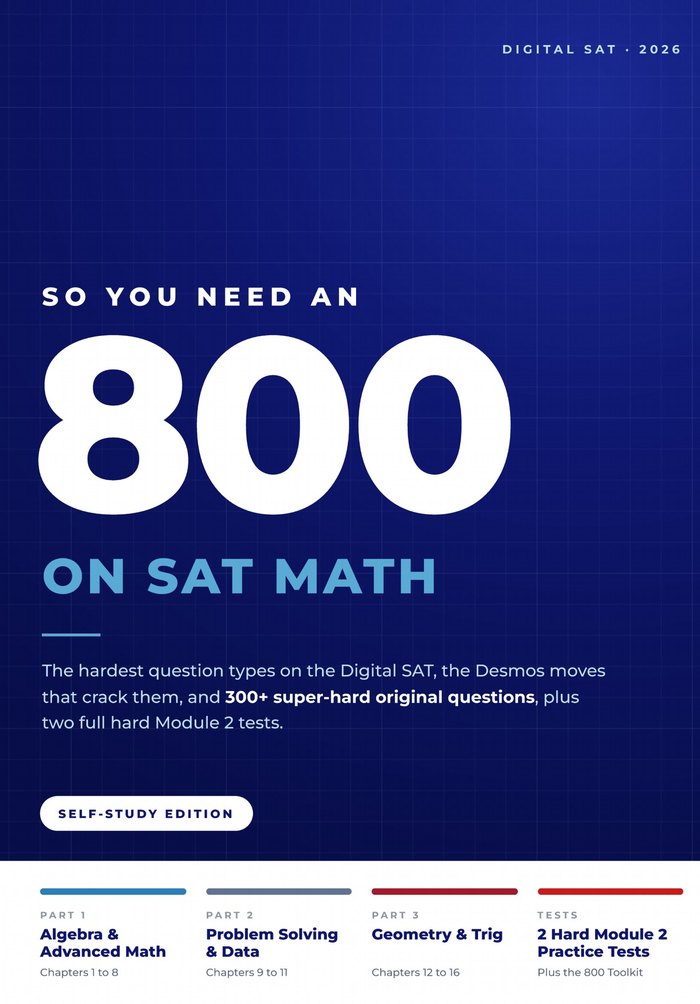
So You Need an 800 The hardest Digital SAT math questions, the patterns behind them, and how to beat them.
The last points on SAT Math come from a short list of question types that repeat. This book takes the hardest of them one chapter at a time: how the test builds the question, the Desmos kill move, the by-hand method, and a 15-question 800 Drill that runs from hard to hardest. 300+ super-hard original questions, plus two full hard Module 2 practice tests.
Paperback and Kindle on Amazon · By Jaclyn Caruana, MBA · Self-Study Edition, 644 pages, A4 · Paperback ISBN 979-8141198953 · From the author of SAT Desmos Hacks
New 2026
300+Super-hard original questions
16Pattern chapters, plus a bonus
15Questions in every 800 Drill
2Hard Module 2 practice tests
How to get an 800 on SAT Math
A 700 student can graph two equations. An 800 student knows how the question was built.
The hardest Digital SAT math questions are not random. The same structures come back form after form, and each one is built to punish one skipped step. So the book is organized by pattern, not by topic, and every pattern chapter runs the same way.
“On recent hard modules, about 7 of the 18 hardest items could be finished faster in Desmos than on paper, but only by a student who knew which of four tools to reach for.” “The algebra is still in every solution, because Desmos never checks your setup.”
From Chapter 0, The 800 Desmos Toolkit
1
The pattern
How the test builds it: where the letter hides, what the question asks one step past the obvious, and which slip costs the point.
2
Three kill moves
Three lessons per chapter. Each has a Work It Together example, a Trap to Know, and a Your Turn question.
3
The Desmos move
What to type, what you see, and why it works, plus the by-hand answer, so you can finish either way and check one with the other.
4
The 800 Drill
15 items, Desmos allowed, hard to hardest, with the answer to every question at the end of the chapter.
Epic tip“Before you type anything, name the tool: tap, slide, solve or fit.” “Thirty seconds of planning beats three minutes of wandering in the graph.”
Caution“Desmos computes; it never interprets.” A wrong setup is solved just as fast and just as confidently, so every screen value is checked against the question's conditions.
Your Desmos screenEach Desmos move is printed as steps: what to type, what you see, and why it works. A Your Desmos Screen page follows it.
The hardest SAT math questions, by pattern
16 question types behind the last points on SAT Math
Part 1 covers Algebra and Advanced Math, the two domains that are each 13 to 15 of your 44 questions on test day. Part 2 covers Problem Solving and Data, and Part 3 Geometry and Trigonometry. Here is what each chapter teaches, in the book's own words where it fits on one line.
1
Algebra
Infinitely many, none or one: parameters in linear systems
The letter sits in two coefficients at once, or the slopes are hidden until you collect. The cross-product test finds the only candidates; the constants decide none or infinitely many.
2
Advanced Math
Discriminant, tangency and sign reasoning
The discriminant as a function of the letter, a count decided by signs alone, and radicals where tangency is not the whole story. In the book's words, “it is usually the item that splits a 760 from an 800.”
3
Advanced Math
Hidden quadratics: substitution, radicals and rational equations
Name the u, solve for u, then filter. “The 800 version asks for a count, a sum or a product of the real solutions, so every one of those fakes changes the answer.”
4
Advanced Math
Roots in disguise: sums, products and shifted roots
Sum and product without solving, when Vieta lies, shifted, scaled and squared roots, and root forms that give the parameter.
5
Advanced Math
Building quadratics from conditions
Build from a vertex and a point, use symmetry and the free values f(1), f(-1) and f(0), and read conditions that bound the leading coefficient.
6
Advanced Math
Factor structure and coefficient matching
Factor in layers and test with the zero, integer factor pairs and the middle coefficient, and matching coefficients with well-chosen inputs.
7
Advanced Math
Exponential forms and re-expressed rates
Re-express a rate for a new time window, compute a feature before looking for it in the display, and pin the curve: divide out a, subtract out c.
8
Algebra
Letters everywhere: literal equations and letter-coefficient lines
Perpendicular lines and the two-line intersection, hidden-linear tables, and literal equations solved with one denominator.
9
Problem Solving and Data
Percent chains
Chain the multipliers, find the missing percent in successive changes, and handle weighted percents and the percent of what is left.
10
Problem Solving and Data
Units that bite: squared and cubed conversions
Squared-unit rates, rates of rates when time is squared, and cubed units: density, volume and the cube root.
11
Problem Solving and Data
Data extremes: bins, means and removing a point
Think in totals, push every value to the wall of its bin, and know what moves and what stays when a point is removed.
12
Geometry
Angle chases: parallel lines, zigzags and bow-ties
Every angle is a or 180 minus a; draw the parallel through every bend; bow-ties and triangle sums.
13
Geometry
Similar triangles, sufficiency and multiple answers
Write the correspondence before the ratios, decide what is enough to prove similarity, and handle the case where the correspondence is not given.
14
Trigonometry
Right triangles and trig: hidden triples and cofunctions
Hidden triples (reduce, scale, then transfer), complements and cofunctions, and symbolic sides in special triangles.
15
Geometry
Circles: equations, completing the square and tangents
Complete the square with a coefficient or a letter, position a point or a second circle, and use the right angle and the kite at a tangent.
16
Geometry
Solids: surface area and scaling chains
Surface area of pyramids and cylinders, back-solving from areas and volumes to a length, and scaling chains and glued solids.
Bonus chapter 17 covers two off-the-bank topics: remainders without dividing, and segments and lenses (sector minus triangle).
Why strong students miss them
The math is short. The point is lost in a skipped step.
Every chapter names the slips that cost 800s. A few, from the first chapters of the book:
Chapter 1 · Parameters in linear systems
Comparing coefficients before the equations are collected; answering “no solution” with every value that makes the slopes equal, when one of them often makes the lines identical; and dividing by a letter that is allowed to be 0.
Chapter 2 · Discriminant and tangency
The newest version of this question gives you no numbers at all, only that a constant is positive, with “There is not enough information” waiting in choice D as bait. The book teaches how to decide the count from signs alone.
Chapter 3 · Hidden quadratics
“Students who learn ‘throw out the negative’ apply it everywhere. It belongs to even roots only.” A cube root keeps its negative answers; a fourth root does not.
Hard digital SAT math practice
Try three questions from the book's 800 Drill
These are items 1, 3 and 4 of the 800 Drill in Chapter 9, Percent Chains, exactly as printed in the book. Try each one first, then reveal the answer and a worked solution.
Chapter 9 · Drill item 1800 Drill
For a positive number \(q\), the numbers \(p\), \(r\), and \(s\) satisfy three conditions: \(p\) is 20% less than \(q\), \(r\) is 150% greater than \(p\), and \(s\) is 0.4% of \(r\). Which of the following expressions is equivalent to \(q + s\)?
A) \(0.504r\)
B) \(0.54r\)
C) \(0.837r\)
D) \(2.004r\)
Answer: A
Turn each sentence into a multiplier: \(p = 0.8q\), \(r = 2.5p\), \(s = 0.004r\).
Chain the first two: \(r = 2.5(0.8q) = 2q\), so \(q = 0.5r\).
Add: \(q + s = 0.5r + 0.004r = 0.504r\).
Choice B comes from reading 0.4% as 0.04. Choice D comes from \(q = 2r\), the chain run backward.
Epic tip: "150% greater than" is \(\times 2.5\), not \(\times 1.5\). Desmos check: set \(q = 100\), build \(p\), \(r\) and \(s\) line by line, then compare \(q + s\) with \(0.504r\).
Chapter 9 · Drill item 3800 Drill
At the start of a year, quantity \(A\) was 36% less than quantity \(B\). During the year, \(A\) increased by \(p\%\) and \(B\) increased by 60%, and at the end of the year the two quantities were equal. What is the value of \(p\)?
Divide by \(0.64B\): \(1 + \tfrac{p}{100} = 2.5\), so \(p = 150\).
Choice D, 250, is the multiplier 2.5 read as a percent. Choice A, 96, adds the percents (36 + 60).
Epic tip: set \(B = 100\) and the whole chain becomes numbers: \(A\) starts at 64 and must reach 160.
Chapter 9 · Drill item 4800 Drill
A farm sold 30% of its apple harvest at a market and sent 40% of the remaining apples to a cannery. It then donated 25% of the apples it still had and stored the rest. The farm sent 1,260 more kilograms of apples to the cannery than it donated. How many kilograms of apples did the farm store?
A) 2,016
B) 2,268
C) 2,940
D) 7,200
Answer: B
Let the harvest be \(H\). After the market, \(0.7H\) is left.
Cannery minus donated: \(0.28H - 0.105H = 0.175H = 1{,}260\), so \(H = 7{,}200\).
Stored: \(0.315 \times 7{,}200 = 2{,}268\). Choice D is the whole harvest, the answer to a question nobody asked.
Epic tip: each percent is "of what is left", so carry the remainder forward before you take the next percent.
Questions from So You Need an 800, Chapter 9, 800 Drill. The worked solutions on this page were written for the web; in the book, every chapter ends with a full answer key.
Look inside
Real pages from the book
The contents: the 800 Toolkit, 16 pattern chapters in three parts, a bonus chapter and two practice tests.A Desmos Move from Chapter 9: what to type, what you see, and why it works.The first page of the Chapter 9 800 Drill: 15 items, Desmos allowed, hard to hardest.
PDFFREE
Free sample
Read all of Chapter 9, Percent Chains, free
The complete chapter from the book, exactly as printed: the pattern, the lessons, the Desmos moves and the full 800 Drill. The answer key is in the book.
How the test builds percent-chain questions, and the traps it sets
Three lessons with Work It Together examples, a Trap to Know and Your Turn questions
Desmos Moves step by step, with Your Desmos Screen pages
The book opens with the calculator moves the rest of it uses at full speed, then drills 15 hard items from all four domains where the calculator honestly beats the pencil, or catches the trap the pencil walks into.
Tap
Graph and tap
Intersections, zeros, maxima and minima, and counts of solutions.
Slide
The slider
For a letter that is allowed to vary. Drag it and watch the count of solutions change.
Solve
The ~ solver
Unknowns with subscripts, and identities forced to hold with a list of x-values.
Fit
Table and regression
Fit a model with several unknown constants through the given points, and read the fit before the numbers.
SAT math 800 book vs SAT Desmos book
So You Need an 800 or SAT Desmos Hacks: which one do you need?
Both books are by Jaclyn Caruana and both use Desmos. They do different jobs.
Built forAny Digital SAT student, especially students aiming for 700+ who run out of time in Module 2
Organized byThe four math domains
Questions100 problems, Easy to Hard
Each problemThree pages: try it, solve it step by step in Desmos, check your screen. An honest label, the trap answer and the by-hand route
DesmosThe whole book: 27 Desmos power moves
ExtrasFree online practice for all 100 problems
Beat the hardest questions
So You Need an 800
Built forStudents who already handle most of the test and lose points on the hardest repeat question types
Organized byQuestion pattern: 16 chapters plus a bonus, in three parts
Questions300+ super-hard original questions; every 800 Drill runs hard to hardest
Each chapterHow the test builds it, three kill moves with a Trap to Know, a 15-question 800 Drill and the answers
DesmosA toolkit chapter, then a Desmos move next to the by-hand method in every lesson
ExtrasTwo full hard Module 2 practice tests
The honest answer: if Desmos still feels slow, or your SAT Math score is below about 700, start with SAT Desmos Hacks. If you already use sliders, regressions and the ~ solver and your missed questions are the last ones in the harder Module 2, start here. The SAT Desmos Hacks explanations are fuller problem by problem; this book goes deeper on fewer patterns and gives you far more hard questions to drill.
Table of contents
Every chapter and every kill move
Chapter 0, chapters 1 to 16 and the bonus chapter each end with an 800 Drill and an answer key. The two practice tests have their own answer sections.
Start The 800 Toolkit
0
The 800 Desmos Toolkit
Sliders: let the letter move
The ~ solver: unknowns with subscripts, identities with lists
Tables and regression: fit the model through the points
800 Drill · 15 items · Answers
Part 1 Algebra and Advanced Math
1
Infinitely Many, None or One: Parameters in Linear Systems
The cross-product test with a letter inside
Rewrite before you compare, and never divide by the letter
Dependent systems, parametric points and "at least one solution"
800 Drill · 15 items · Answers
2
Discriminant, Tangency and Sign Reasoning
Write the discriminant as a function of the letter
Sign reasoning: decide the count without computing
Radicals: tangency is not the whole story
800 Drill · 15 items · Answers
3
Hidden Quadratics: Substitution, Radicals and Rational Equations
Name the u, solve for u, then filter
Radicals: raise the power, then let u be the inside power
Rational equations: clear, solve, then delete
800 Drill · 15 items · Answers
4
Roots in Disguise: Sums, Products and Shifted Roots
Sum and product without solving, and when Vieta lies
Shifted, scaled and squared roots
Root forms give the parameter
800 Drill · 15 items · Answers
5
Building Quadratics from Conditions
Build from a vertex and a point, then transform
Symmetry and the free values f(1), f(-1), f(0)
Conditions that bound the leading coefficient
800 Drill · 15 items · Answers
6
Factor Structure and Coefficient Matching
Factor in layers, then test with the zero
Integer factor pairs and the middle coefficient
Match coefficients, and choose the inputs
800 Drill · 15 items · Answers
7
Exponential Forms and Re-expressed Rates
Re-express the rate for a new window
Displays: compute the feature, then look for it
Pin the curve: divide out a, subtract out c
800 Drill · 15 items · Answers
8
Letters Everywhere: Literal Equations and Letter-Coefficient Lines
Perpendicular lines and the two-line intersection
Hidden-linear tables and letter inputs
Literal equations: one denominator, then isolate
800 Drill · 15 items · Answers
Part 2 Problem Solving and Data
9
Percent Chains
Chain the multipliers
Successive changes and the missing percent
Weighted percents and the percent of what is left
800 Drill · 15 items · Answers
10
Units That Bite: Squared and Cubed Conversions
Squared-unit rates
Rates of rates: when time is squared
Cubed units: density, volume and the cube root
800 Drill · 15 items · Answers
11
Data Extremes: Bins, Means and Removing a Point
Think in totals: add, remove, combine
Bins: push every value to the wall
Remove a point: what moves and what stays
800 Drill · 15 items · Answers
Part 3 Geometry and Trigonometry
12
Angle Chases: Parallel Lines, Zigzags and Bow-Ties
Every angle is a or 180 minus a
Zigzags: draw the parallel through every bend
Bow-ties and triangle sums
800 Drill · 15 items · Answers
13
Similar Triangles, Sufficiency and Multiple Answers
Write the correspondence, then the ratios
Sufficiency: what is ENOUGH to prove it
When the correspondence is not given
800 Drill · 15 items · Answers
14
Right Triangles and Trig: Hidden Triples and Cofunctions
Hidden triples: reduce, scale, then transfer
Complements: side letters, cofunctions and the 45° line
Symbolic sides and special triangles
800 Drill · 15 items · Answers
15
Circles: Equations, Completing the Square and Tangents
Complete the square with a coefficient or a letter
Position: points, axes and a second circle
Tangents: the right angle and the kite
800 Drill · 15 items · Answers
16
Solids: Surface Area and Scaling Chains
Surface area forward: pyramids and cylinders
Back-solving: from areas and volumes to a length
Scaling chains and glued solids
800 Drill · 15 items · Answers
Bonus Off-the-Bank Topics
17
Bonus: Off-the-Bank Topics
Remainders without dividing
Segments and lenses: sector minus triangle
800 Drill · Answers
Tests Hard Module 2 Practice Tests
T1
Practice Test 1
T2
Practice Test 2
Who this book is for
Built for the last few questions
Students aiming for 750 to 800
You get most questions right and lose points on the same hard types in the harder Module 2. The book drills exactly those types.
Students who know Desmos
The book assumes you can graph and tap, then teaches sliders, the ~ solver and regression at full speed, and when the algebra is still needed.
Tutors and classes
Every lesson has a Work It Together example to solve in class, a Your Turn question for the student, and a 15-question drill for homework.
Published Author
Meet the author
Jaclyn Caruana
Co-founder, Epic Exam Prep · MBA · Barcelona since 2010
I co-founded Epic Exam Prep in 2010 and have spent more than 15 years helping students reach scores they once thought were impossible. So You Need an 800 is for the students who are already close: it collects the hardest question types I see on the Digital SAT and the moves that beat them.
Co-founder of Epic Exam Prep, founded in 2010, with offices in Barcelona, Madrid, Milan and Zurich plus online lessons
15+ years teaching; the Epic Exam Prep team brings 25 years of combined expertise
Epic Exam Prep students gain 200+ SAT points on average; 1,000+ students now study at top universities
So You Need an 800 is a Digital SAT Math book by Jaclyn Caruana, MBA, for students who are already strong and want the last points. Each chapter takes one of the hardest repeat question types on the Digital SAT, shows how the test builds it, teaches the Desmos kill move and the by-hand method, then drills it with 15 super-hard questions. Two full hard Module 2 practice tests close the book.
The cover counts 300+ super-hard original questions. Chapter 0 and each of the 16 pattern chapters end with a 15-question 800 Drill, every lesson adds worked examples and a Your Turn question, the bonus chapter has its own drill, and two full hard Module 2 practice tests close the book.
Parameters in linear systems (no solution, infinitely many, exactly one); the discriminant, tangency and sign reasoning; hidden quadratics; sums, products and shifted roots; building quadratics from conditions; factor structure and coefficient matching; exponential forms and re-expressed rates; literal equations and letter-coefficient lines; percent chains; squared and cubed unit conversions; data extremes; angle chases; similar triangles and sufficiency; hidden triples and cofunctions; circles and tangents; and solids and scaling chains. A bonus chapter covers remainders and circle segments.
SAT Desmos Hacks is a Desmos book: 100 problems from Easy to Hard, each solved step by step in Desmos, with an honest label that says when the calculator wins. So You Need an 800 is a hard-questions book: it starts where a 700 student stops, sorts the hardest questions into patterns, and teaches both the Desmos kill move and the algebra for each one, then drills 15 hard to hardest questions per pattern and adds two hard Module 2 practice tests.
If Desmos still slows you down, or your SAT Math score is below about 700, start with SAT Desmos Hacks. If you already use sliders, regressions and the tilde solver and you lose points only on the last questions of the harder Module 2, start with So You Need an 800. Many students use both: Desmos Hacks for the tools, So You Need an 800 for the hardest patterns.
Yes, and you also need algebra. Chapter 0, The 800 Desmos Toolkit, teaches four tools at full speed: graph and tap, the slider, the tilde solver with subscripts and lists, and the table with a regression. Every chapter then pairs a Desmos move with the by-hand method, because Desmos computes but never checks your setup.
Yes. In the Self-Study Edition every chapter ends with an answer key for its Your Turn questions and its 800 Drill, and the practice tests have their own answer sections. Each Desmos move is printed step by step, with what to type and what you should see. The Work It Together examples are set up to be solved in class with a teacher.
No. The questions are original, written to match the structures of the hardest Digital SAT math questions. SAT is a registered trademark of the College Board, which is not affiliated with and does not endorse this book.
Get the medium questions right fast, then win the hardest ones. The hardest Digital SAT math questions repeat a small number of patterns, and each pattern has a trap that costs strong students the point: a skipped step, a fake root, a boundary value that was never tested. So You Need an 800 teaches those patterns one chapter at a time and drills them until the trap is automatic. Use the Digital SAT score calculator on PrepDrills to see where your practice tests stand.
It is sold on Amazon as a paperback and a Kindle edition. Use the Get the paperback or Get the Kindle edition buttons on this page.
Stop losing the last points.
16 hard SAT math patterns, the Desmos kill move and the by-hand method for each, 300+ super-hard original questions and two full hard Module 2 practice tests.