Quick answer: The Online Bocconi Test is a 50-question, 75-minute admissions exam for Bocconi bachelor and law programs. For economics and management programs it covers Mathematics (24 questions), Reading Comprehension (11), Critical Thinking (9) and Numerical Reasoning (6). Correct answers score +1, blanks 0, and wrong answers −0.2 (or −0.33 on three-option critical-thinking items). You need at least 17/50 to stay in selection, you may take the test up to four times keeping your best score, and no calculator is allowed. For every bachelor program except Law, you can submit the SAT instead, and Bocconi counts whichever result is higher.
If you're applying to a Bachelor of Science or Law program at Bocconi University, the Online Bocconi Test is the single biggest academic hurdle between you and an offer. It's a 50-question, 75-minute exam that decides a large share of your admission score, and because it penalizes wrong answers, knowing exactly what's on it (and how it's scored) is worth as much as raw ability.
This guide breaks the test down section by section, shows you a worked sample question for each part, and lays out the recurring traps we found after analyzing three full simulation papers. It also covers the SAT route you can pair with it (Bocconi keeps your better result). Everything here reflects the 2027/28 admissions cycle (applications open in 2026). For the full application timeline with session deadlines and strategy, see our Bocconi application timeline 2027-2028.
Quick facts: the Online Bocconi Test at a glance
| Feature | Detail |
|---|---|
| Questions | 50 multiple-choice |
| Time | 75 minutes (about 90 seconds per question) |
| Language | Italian or English (your choice) |
| Sections (Business/Economics) | Mathematics (24), Reading Comprehension (11), Critical Thinking (9), Numerical Reasoning (6) |
| Scoring | +1 correct, 0 blank, −0.2 wrong (−0.33 on some 3-option critical-thinking items) |
| Minimum valid score | 17/50 (below this you're excluded from selection) |
| Competitive score | Around 35/50 (observed coaching estimate, not an official cutoff) |
| Attempts | Up to 4 per test type while the platform is open |
| Calculator | Not allowed |
| Format | Online, from home, with live proctoring (webcam plus a second device) |
Two versions exist. The mix above is for business and economics programs. The Law version keeps the same 50 questions and 75 minutes but reweights them heavily toward logic and language (more on that below).
You can stack the odds in your favour. For every bachelor program except Law, Bocconi lets you submit both the Bocconi Test and the SAT (or ACT) and keeps your better result. So the winning move is to prepare for the Bocconi Test properly and treat the SAT as a free second shot, not to skip one for the other. See the SAT route below.
What is the Bocconi Test, and who takes it?
The Online Bocconi Test is the admissions exam for Bocconi's undergraduate (Bachelor and Law) programs. You're eligible if you've already earned your upper-secondary diploma or will earn it during the 2027/28 school year.
You take it remotely on Bocconi's web-testing platform, and you can sit it in either Italian or English regardless of the language your target program is taught in. (Note: English-taught programs still require separate English certification such as TOEFL or IELTS. The Bocconi Test itself does not certify your English. See our TOEFL for Bocconi guide for the exact band requirement and section expectations, or our TOEFL preparation guide for Italy if you need to plan that alongside your Bocconi prep.)
Sessions and deadlines (2027/28):
- International applicants: application window July 13, 2026 to January 19, 2027, with an Early Session and a Winter Session inside that window.
- Italian applicants: application window July 13, 2026 to April 20, 2027.
Because admission is rolling and places fill as sessions close, sitting the test early is a real strategic advantage: the earlier sessions compete for a larger pool of open seats. (Confirm the exact Early and Winter session dates on Bocconi's official selection-process page before you plan, as Bocconi sets them each cycle.) Italian speakers can find the full deadline calendar in our scadenze Bocconi 2027-2028 guide.
You get up to four attempts. Your best score is what counts, so there's no downside to a first attempt other than the effort. Treat attempt one as a diagnostic if you must, but walk in prepared, because a strong early score can lock in a place before later rounds tighten.
How is the Bocconi Test scored?
This is the part most applicants underestimate. Scoring is:
- Correct answer: +1 point
- Blank (no answer): 0 points
- Wrong answer: −0.2 points (five-option questions)
- Wrong answer: −0.33 points on certain 3-option critical-thinking questions
Two consequences follow directly from these numbers, and they should govern how you take the test:
- A blind guess on a 5-option question is roughly break-even. Expected value = (1/5)(+1) + (4/5)(−0.2) = 0. So random guessing neither helps nor hurts on average, but educated guessing (eliminating even one option) tips the expected value positive. Eliminate, then guess. Leave truly blank only what you can't dent.
- The 3-option critical-thinking items punish harder (−0.33). Here a pure blind guess is also break-even, but the cost of being wrong is higher, so only answer these when you can eliminate at least one choice.
The minimum valid score is 17/50. Score below that and you're removed from selection entirely. Competitive candidates generally aim for 35 and up (an observed coaching benchmark, since Bocconi publishes no official competitive cutoff). Since the test is about 48% math, your math accuracy is usually the difference between "valid" and "competitive."
You can't learn negative marking by reading about it. The eliminate-then-guess instinct only forms under a live clock with points on the line. Take the free 15-question demo, scored exactly like the real test with the same negative marking, and see where you stand in 23 minutes. No card required.
Free 15-question demo
See where you stand before test day
15 questions, all four sections, timed with real negative marking. No card. Then unlock all 4 full-length mocks (200 questions, 75-minute timer, worked solutions) for €49.99 and save €30 vs buying individually.
Start the free demo →What are the four sections of the Bocconi Test?
Here's what each part actually asks, how much it's worth, the sub-topics that recur, a worked example in the real style of the test, and how to attack it.
1) Mathematics and Problem Solving: 24 questions (about 48%)
This is half your score. It's the highest-yield section and the one where preparation pays off fastest, because the content is finite and none of it requires calculus.
What it covers:
- Algebra: quadratics and the discriminant, factoring, literal equations (solving for a variable), fractions, absolute-value equations and inequalities, expanding expressions
- Functions: domain and range, even vs. odd, asymptotes, reading a graph, finding a formula from a table
- Analytic geometry: lines, circles, parabolas, midpoint, distance, parallel and perpendicular
- Plane geometry: area (including the shoelace formula), triangle inequality, perimeter
- Trigonometry: right-triangle ratios, the identity sin²x + cos²x = 1, cosine and sine graphs
- Systems of equations: unique, no, or infinitely many solutions
- Probability: simple, conditional P(A given B), mutually exclusive events
- Combinatorics: "choose k of n," permutations of words with repeated letters, counting arrangements
- Sets, sequences, logarithms and exponentials, number theory, statistics (weighted means)
- Problem solving: work and rate problems, unit conversions, percentages, mixtures and weighted averages
Worked example (Algebra):
For which values of k does the equation x² + 4x + k = 0 have two distinct real solutions?
A) k < 4 B) k ≤ 4 C) k > 4 D) k = 4 E) k ≥ 4
Answer: A. Two distinct real roots require a positive discriminant: b² − 4ac > 0, so 16 − 4k > 0, so k < 4. (Watch the wording: "two distinct" means strictly greater than zero, so the answer is k < 4, not k ≤ 4. If it said "at least one real solution," the answer would be k ≤ 4.)
How to attack it: Speed and accuracy on secondary-school algebra and geometry win here, not cleverness. Memorize the discriminant conditions, the special-product expansions, the log rules, the combinatorics formulas (nCk and n!/repeats), and the distance, midpoint and area formulas cold. With no calculator, drill mental arithmetic. Aim to bank most of these 24 points quickly so you have time for the trickier sections.
2) Reading Comprehension: 11 questions (about 22%)
What it covers: short passages (often on science, history, culture, law, or economics) followed by questions about what the text says. Typical tasks:
- Detail or what is stated: locate an explicitly given fact
- "Which statement is (not) in line with the passage"
- Word or phrase meaning in context
- Reference: what a pronoun or phrase points to
- Author's purpose or main idea
The defining feature: the answer is in the text. You are not rewarded for outside knowledge. In fact, plausible-sounding options that go beyond what the passage states are the classic wrong answers.
Worked example:
"The bottleneck effect describes the sharp loss of genetic variability that a population can undergo when its numbers collapse, after a natural disaster, say, so that the survivors carry only a fraction of the original gene pool. Even if the population later rebounds in size, that lost diversity is not automatically restored."
According to the passage, the bottleneck effect refers to:
A) the increase in population size after a disaster
B) the loss of genetic variability a population may experience
C) the permanent extinction of a species
D) a rise in mutation rates among survivors
E) the migration of survivors to new territory
Answer: B. The passage defines it directly as a "loss of genetic variability." C overstates it (the population can rebound), and D and E introduce ideas the text never mentions, the textbook "beyond the passage" traps.
How to attack it: Read the question before re-reading the passage, then hunt for the exact supporting line. If an option requires you to assume something the author didn't write, eliminate it. These are among the most reliable points on the test, so don't rush them to save time for math.
3) Critical Thinking: 9 questions (about 18%)
This section grew for the 2026 redesign (up from 4 questions) and now carries real weight. Some items have 3 options with a −0.33 penalty, so treat them with respect.
What it covers:
- Deductive puzzles: people ranked, seated, or related to each other; you pick the statement that must be true (or must be false)
- True, False, or Cannot-be-derived from a short passage: evaluating whether a claim follows from the text
- Inference: "it can be deduced that," "it is reasonable to expect that"
- Conditional and quantifier logic: contrapositives, negating "some/all," spotting a counterexample
- Necessary vs. sufficient conditions, causation vs. correlation, hidden assumptions, logical fallacies
Worked example (deductive logic):
Five runners, P, Q, R, S, T, finish a race with no ties. We know: Q finished ahead of R; S finished immediately after P; T did not finish last; R finished ahead of P. Which of the following must be true?
A) Q finished first B) P finished ahead of R C) S did not finish first D) T finished second
Answer: C. Since S finishes immediately after P, someone (P) is always ahead of S, so S can never be first. That must be true. A, B and D can each be arranged to be false, so none of them is forced. (The skill being tested: separate what must follow from what could be true.)
How to attack it: For puzzles, sketch the ordering or grid on your scratch paper, don't hold it in your head. For "true, false, or cannot be derived," the trap answer is usually a statement that's plausible in the real world but not supported by the specific text; "cannot be derived" is a legitimate and frequently correct choice. For conditional logic, remember: the contrapositive of "all A are B" is "if not B, then not A," and the negation of "some X are Y" is "no X are Y."
4) Numerical Reasoning: 6 questions (about 12%)
The smallest section, but a common place to lose easy points to careless reading.
What it covers: a table, bar, line or pie chart, or a short data-heavy passage, followed by a question that requires reading the data correctly and doing a short calculation: ratios, percentages, totals, or a two-step figure. This is data interpretation, not advanced math.
Worked example:
A company's revenue grew 3.8% in 2019, compared with 3.2% growth in 2018. Based only on this, which statement is correct?
A) Revenue grew by 0.6% in 2019
B) The 2019 growth rate was more than 3 percentage points above 2018
C) Revenue grew by 3.8% in 2019, and its growth rate was 0.6 percentage points higher than in 2018
D) Revenue was 3.2% higher than in another country
E) None of the above
Answer: C. This is the section's signature trap. Revenue grew 3.8%; the 0.6 is the gap between the two growth rates (3.8 − 3.2), not the growth itself. Option A confuses the percentage-point gap with the growth rate, exactly the mistake the wrong options are built to catch.
How to attack it: Slow down and read the units and labels before you compute. In Numerical Reasoning, the wrong options are almost always the numbers you'd get from a slightly wrong calculation (mixing up a percentage-point difference with a percentage, reading a raw count as a ratio, or picking the total instead of the part). Careful reading beats arithmetic speed here.
A look inside the mocks
Every item is styled and scored exactly like the real exam, with the same three-per-page layout and the same negative marking. Watch the demo in action, then see three sample questions below:
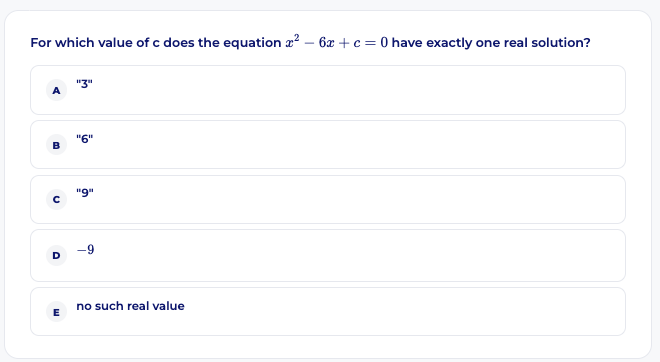
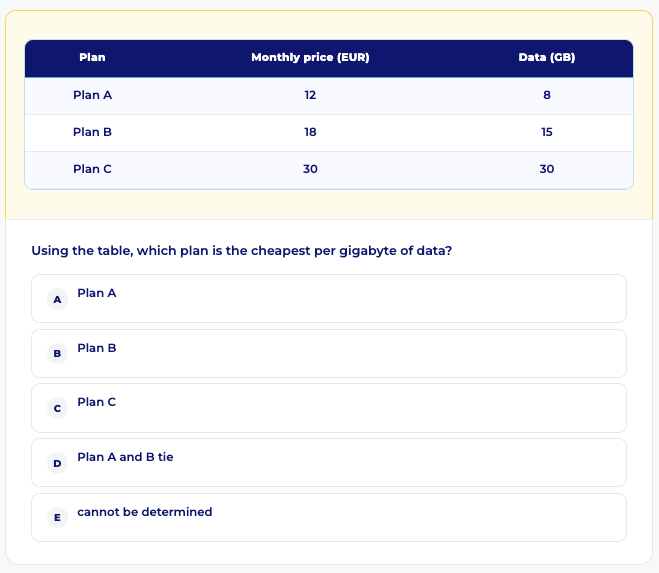
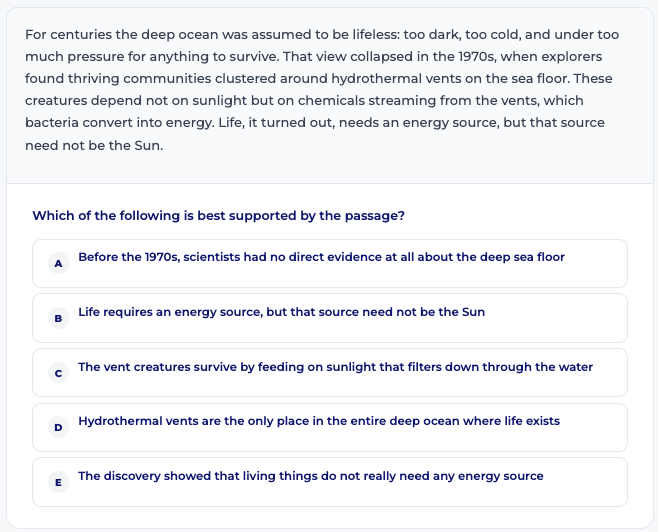
All 15 demo questions are free, timed, and scored the way Bocconi scores them. No card. Start the free demo.
How is the Law version different?
If you're applying to a Law program, the same 50 questions and 75 minutes are reweighted dramatically toward reasoning and language:
| Section | Business/Economics | Law |
|---|---|---|
| Mathematics | 24 | 5 |
| Reading comprehension | 11 | 11 |
| Numerical reasoning | 6 | 6 |
| Logic and critical thinking | 9 | 18 |
| Verbal reasoning | none | 10 |
If Law is your target, flip your prep priorities: logic, critical thinking, and verbal reasoning together make up over two-thirds of the paper, and math is almost a rounding error. (Law applicants can also use the LSAT instead of the Bocconi Law test; the SAT is not accepted for Law.)
The SAT route: a second shot, not a replacement
Here's a rule most applicants miss, and it changes your strategy: for every bachelor program except Law, Bocconi lets you submit both the Bocconi Test and the SAT (or ACT), and automatically counts whichever result is higher.
That is not a reason to skip the Bocconi Test. It's a reason to prepare for it seriously and add the SAT as a free insurance policy on top. Prep the Online Bocconi Test as your primary exam: it's the most direct, lowest-cost path into Bocconi, and with focused practice on real full-length mocks it is very beatable. Then, if your timeline allows, sit the SAT too. It can only lift your Bocconi application, and it travels to other universities across Europe and the US if you're keeping options open.
The SAT logistics, quickly:
- Only SAT scores from 2021 onward are accepted.
- Scores must be sent officially through the College Board using Bocconi's institutional code 7206. A screenshot upload won't count.
- No superscore: Bocconi takes your best single-sitting total, not your best Math plus your best Reading from different dates.
- Delivery takes 1 to 2 weeks, so send your scores well before the deadline.
Deciding how to split your prep, or targeting a specific SAT score? We built a full side-by-side breakdown plus a free interactive Admission Estimator (enter your SAT, GPA, program and session for a competitiveness estimate) in our companion guide: SAT vs. the Bocconi Test, with a free Admission Estimator. For how SAT scores map to Italian university admission specifically, see the SAT-to-Italian-university score chart. Italian speakers can read our guida completa SAT per Bocconi in italiano.
The recurring traps (what we learned from three full papers)
We worked through three complete Bocconi simulation tests (150 questions) and the same patterns showed up again and again. Learn these and you'll avoid the most common avoidable losses:
- Systems of equations that secretly reduce to the same line. A "solve this system" question where both equations are multiples of each other means the answer is "infinitely many solutions." This appeared in every paper. Always check whether one equation is just a scaled copy of the other before you start solving.
- "None of the other answers is correct" is a real, correct option. Test-takers avoid it on instinct. Sometimes it's genuinely right, especially on algebra-expansion questions where none of the printed forms match your result. Don't rule it out.
- The percentage-point vs. growth-rate trap (see the Numerical Reasoning example). A gap between two rates is not a rate.
- "Cannot be derived from the text" is often the right answer in critical thinking. Don't force a true/false verdict when the passage simply doesn't say.
- Answer length is not a tell. The correct option is not reliably the longest or the most detailed. Well-built Bocconi items neutralize this.
- Wrong options are engineered from the almost-right method. In math and numerical reasoning, the distractors are the results of the common mistakes. Getting a listed answer is not confirmation you're right.
- Passages and item types recur across papers. Doing past simulations is high-value: you'll meet the same templates, and occasionally the same passages, on the real thing.
These traps are muscle memory, not trivia. You only learn to spot them by meeting them under timing, and our 4 full mocks name the trap in the worked solution of every item. Start free with the 15-question demo, then unlock all four mocks for €49.99.
How should you approach the 75 minutes?
A simple, score-maximizing game plan:
- Do a fast first pass. Answer every question you can solve confidently in under about 60 seconds, most of the easy and medium math and the single-fact reading questions. Bank those points.
- Flag and skip anything that will take a while: multi-step data tables, long deductive puzzles, unfamiliar math.
- Second pass: the flagged items. Now spend your remaining time on the hard math and Numerical Reasoning tables, where the points are real but slow.
- Guess strategically at the end. On 5-option questions, if you can eliminate even one choice, answer it (positive expected value). On 3-option critical-thinking items (−0.33), only answer if you've eliminated at least one. Leave the rest blank: a blank is 0, a wrong 5-option answer is −0.2.
- Watch the clock. About 90 seconds per question is the average, but the easy ones should take 30 to 45 seconds so the hard ones can take two minutes.
How do you prepare (a 4 to 6 week plan)?
Because the content is finite, focused practice moves your score fast. A realistic plan:
- Weeks 1 to 2, rebuild the math core. Cover every math sub-topic above until each is automatic: discriminant conditions, log and exponent rules, combinatorics formulas, coordinate geometry, probability. This is about half the test, so protect it.
- Week 3, drill the two logic machines. Deductive and seating puzzles, and "true, false, cannot be derived" items. Practice contrapositives, quantifier negation, and spotting counterexamples until they're reflexive.
- Week 4, Numerical Reasoning under time. Practice reading tables and charts and doing the two-step calculation fast and accurately, with special attention to units and the percentage-point trap.
- Weeks 5 to 6, full timed simulations. Sit complete 50-question, 75-minute papers, then review every miss: was it knowledge, a careless read, or a trap? Convert each mistake into a rule you won't break again. Track your score against the 35-plus benchmark.
The single highest-return habit is timed, full-length practice with honest review. It builds the pacing and the trap-recognition that separate a valid score from a competitive one.
Rehearse the real thing four times before it counts. PrepDrills has 4 full-length Bocconi mocks: 200 exam-style questions across all four sections, real 75-minute timing, real negative marking, and a worked solution on every single item. See the platform first with the free 15-question demo, no card, then unlock all four mocks for €49.99, which is €30 off buying them one at a time (and instant if you're already Pro). Test day belongs to the student who has already sat the test, four times. See the Bocconi practice exams and start free. Want a faster path? Epic Exam Prep offers one-on-one Bocconi coaching.
Frequently asked questions
How many questions are on the Bocconi Test?
50 multiple-choice questions in 75 minutes. For business and economics programs: 24 Mathematics, 11 Reading Comprehension, 9 Critical Thinking, 6 Numerical Reasoning. The Law version reweights toward logic and verbal reasoning.
Is there negative marking on the Bocconi Test?
Yes. Correct answers score +1, blanks score 0, and wrong answers score −0.2 (or −0.33 on certain 3-option critical-thinking questions). Blind guessing on a 5-option question is break-even; educated guessing (after eliminating an option) is positive.
What score do I need?
You must score at least 17/50 (penalties included) to remain in the selection process. Competitive applicants generally target 35-plus, an observed coaching benchmark rather than an official Bocconi cutoff.
Can I take the Bocconi Test more than once?
Yes, up to four attempts per test type while the web-testing platform is open. Your best score counts.
Can I use a calculator?
No. All arithmetic is done by hand, which is why mental-math speed matters on the math and numerical-reasoning sections.
In what language is the test?
You choose Italian or English, independent of your program's teaching language. English-taught programs still require separate English certification (for example TOEFL or IELTS).
Is math or logic more important?
For business and economics, math dominates at about 48% of the test. For Law, logic, critical thinking, and verbal reasoning together make up more than two-thirds, so prioritize accordingly.
Can I use the SAT instead of the Bocconi Test?
Yes, for every bachelor program except Law (which uses the LSAT or the Bocconi Law test). Bocconi accepts SAT and ACT scores from 2021 onward, sent officially via College Board code 7206. But you don't have to choose: you can submit both the SAT and the Bocconi Test, and Bocconi automatically keeps your better result, so the strongest move is to prep the Bocconi Test and add the SAT as a second shot. See our SAT vs. Bocconi Test guide to plan the split.
What SAT score do I need for Bocconi?
Bocconi publishes no official minimum. Our full SAT vs. Bocconi guide has the observed competitive bands and a free Admission Estimator. Note Bocconi does not superscore; it uses your best single-sitting total.
How is the Law version of the Bocconi Test different?
The Law version keeps 50 questions and 75 minutes but reweights toward reasoning and language: Mathematics drops to 5 questions, Logic and Critical Thinking rises to 18, and a new Verbal Reasoning section of 10 questions is added. Reading Comprehension (11) and Numerical Reasoning (6) stay the same.
How can I practice for the Bocconi Test?
Start with PrepDrills' free 15-question demo: all four sections, timed with real negative marking, no card. Then our 4 full-length mocks give you 200 exam-style questions with a worked solution on every item, for €19.99 each or €49.99 for all four. See full details on our Bocconi practice exams page, or go straight to the mocks.
Sources: Bocconi University official admissions pages (unibocconi.it, Online Bocconi Test and selection process), cross-checked against three full Bocconi simulation papers analyzed by PrepDrills, and PrepDrills' SAT vs. Bocconi Test and Digital SAT Italy score guides. Section weightings, scoring, SAT rules and deadlines reflect the 2027/28 admissions cycle; always confirm the current year's rules on Bocconi's official site before your test date.