The Japanese Math and Digital SAT Format Gap
Japanese math education, from 中学 through 高校, is rigorous and heavily formula-based. The curriculum emphasizes multi-step algebraic derivation, and 塾 (juku) prep culture reinforces showing every step of the working. Students trained in 数学I, 数学II, and 数学III develop exceptionally strong algebraic intuition. But the Digital SAT does not reward elegant derivation. It rewards correct answers produced quickly. A student who solves a system of equations by substitution in 90 seconds and a student who graphs both equations in Desmos and clicks the intersection in 15 seconds get the same point. Across 44 Math questions, those seconds compound into 50 to 100 points of score difference. Our complete guide to Desmos on the Digital SAT covers the full strategic framework, and the Singapore version of this guide covers the same techniques for a different curriculum context.
The Five Desmos Techniques That Matter Most for Japan Students
These five techniques cover the majority of SAT Math questions where Desmos is faster than hand-solving. Each replaces a specific algebraic instinct that juku and 数学 training reinforce. The full set of 57 worked problems is in SAT Desmos Hacks: The EPIC Method.
1. The Intersection Method
Type two equations into Desmos and click the intersection point. This replaces the 連立方程式 (simultaneous equations) methods drilled in juku: substitution, elimination, and matrix approaches. On the SAT, systems appear in 4 to 6 questions per test. Hand-solving takes 60 to 90 seconds. Desmos intersection: 15 seconds.
Japanese students instinctively reach for algebraic elimination when they see two equations. Building the Desmos reflex of typing both equations and looking at the graph is the single highest-return change. See our Desmos cheat sheet for a printable reference.
2. The Slider Method
When a problem includes an unknown parameter, define it as a slider in Desmos and drag until the graph matches the stated condition. This replaces the algebraic approach of isolating the parameter, which juku trains extensively through パラメーター (parameter) manipulation exercises. Hand-solving: 90 to 120 seconds. Slider method: 20 to 30 seconds.
Students from 数III backgrounds who are comfortable with parametric curves will understand the concept instantly. The speed gain comes from not having to derive the solution algebraically.
3. The Regression Method
For data-fitting questions, use Desmos regression with the tilde operator: y1 ~ ax1 + b for linear, y1 ~ ax1^2 + bx1 + c for quadratic. This replaces manual least-squares calculation or calculator menu navigation. Desmos regression is one line of input with instant output.
IB students at Yokohama International or Nishimachi who use a GDC will find Desmos faster. Students from Japanese 高校 who do regression by hand will find it dramatically faster. Either way, 30 to 60 seconds saved per question.
4. The Inequality Shading Method
Type an inequality and Desmos shades the solution region automatically. For systems of inequalities, type both and the overlap is the answer. This replaces the manual graphing and test-point process. Inequality questions appear on 2 to 3 SAT questions per test. Hand-graphing: 2 to 3 minutes. Desmos: 10 seconds.
Japanese 数学I covers linear inequalities extensively, but the visual speed of Desmos makes the hand-solving approach unnecessary on a timed test.
5. The Function Analysis Method
Type any function into Desmos and read the minimum, maximum, roots, y-intercept, and vertex directly from the graph. This replaces completing the square (平方完成) and derivative-based max/min methods from 数II/III. Desmos shows all key features visually with one click. Saving: 30 to 45 seconds per question.
The Book Behind This Guide
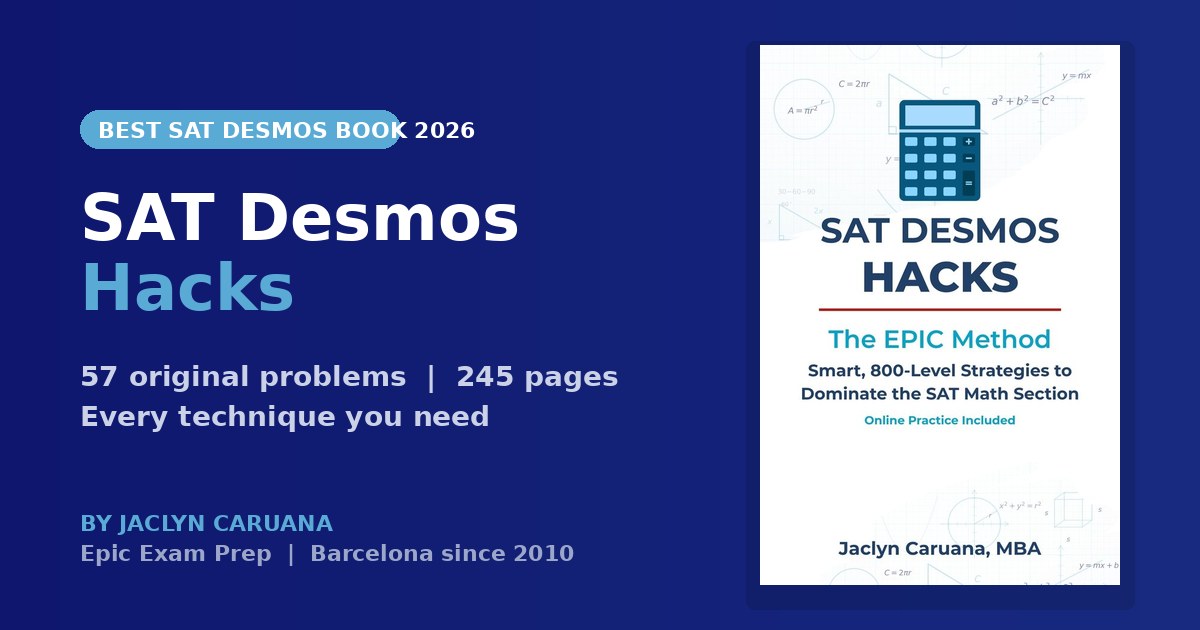
SAT Desmos Hacks by Jaclyn Caruana covers all five techniques with 57 original SAT-style problems and step-by-step Desmos solutions.
Includes online practice at desmos.prepdrills.com
Kindle: US$9.99 → Paperback: US$34.99Curriculum-Specific Notes
AP curriculum at international schools (ASIJ, K International): Students at the American School in Japan (ASIJ) and K International School Tokyo follow AP or US-aligned curricula and typically have some Desmos exposure. Their gap is technique-specific: they know Desmos exists but have not practiced the five SAT-optimized techniques systematically. The transition is fast, usually 2 to 3 sessions.
IB Diploma (Yokohama International, Nishimachi): IB students taking the SAT use a GDC extensively in Math AA and AI courses. Desmos is familiar in concept but different in interface. The tilde for regression, the slider for parameters, and one-click intersection are Desmos-specific shortcuts that need dedicated practice.
Japanese high school + 帰国子女 (kikokushijo) returnee track: Returnee students who studied abroad and came back to Japan often need SAT for English-medium university admission. Their Japanese 数学 foundation is strong, and Desmos techniques layer on top of that foundation to add speed. This group typically sees the largest score gains because their algebra is excellent and the Desmos layer is purely additive.
English-medium university targets (Waseda SILS, Keio PEARL, Sophia FLA, ICU, Temple Japan): These programs accept or require SAT for admission. Waseda SILS typically looks for 1300+, Keio PEARL for 1350+, and ICU and Sophia FLA consider SAT alongside other criteria. Students targeting these programs alongside US universities benefit from a single SAT preparation strategy that maximizes their Math score.
SAT Test Centers in Japan
The Digital SAT is administered at international schools throughout Japan, including ASIJ (American School in Japan, Chofu), Nishimachi International School (Minato), Yokohama International School, K International School Tokyo, and Tokyo YMCA. Test dates follow the international SAT schedule. The Bluebook application with built-in Desmos runs on school-provided devices at all centers. For full registration details, deadlines, and fees for international students, see our dedicated guide. Use our Digital SAT score calculator to estimate your score from practice results, and our 51-day study plan if you are preparing for an upcoming test date.
The Book: SAT Desmos Hacks
SAT Desmos Hacks: The EPIC Method for Smart, Fast, 800-Level Math by Jaclyn Caruana covers all five techniques with 57 original SAT-style problems across all four Math domains. Every problem includes a step-by-step Desmos solution with screenshots. The EPIC Method framework (Engage, Pinpoint, Interpret, Choose) gives you a repeatable decision process. Kindle is available on amazon.co.jp for instant access in Japan.
Get the Book
Available worldwide. Japan students can order the Kindle edition for immediate access or the paperback via Amazon Global shipping.
Kindle also available on amazon.co.jp