The Singapore Math Gap
Singapore's math curriculum, whether JC H2, IB Higher Level, or IGCSE Additional Mathematics, trains students to solve problems with algebraic elegance. The emphasis is on showing work, deriving solutions step by step, and demonstrating mathematical reasoning. This is excellent preparation for university mathematics, but it creates a specific disadvantage on the Digital SAT. The SAT does not reward elegant derivation. It rewards correct answers produced quickly. A student who solves a system of equations by substitution in 90 seconds and a student who graphs both equations in Desmos and clicks the intersection in 15 seconds receive the same point. The second student has 75 extra seconds to spend on a harder question. Across 44 Math questions, those seconds compound into a measurable score difference. Our complete guide to Desmos on the Digital SAT covers the full strategic framework.
The Five Desmos Techniques That Matter Most for Singapore Students
These five techniques cover the vast majority of SAT Math questions where Desmos is faster than hand-solving. Each one replaces a specific algebraic instinct that Singapore Math programs train heavily. The full set of 57 worked problems across all five techniques is in SAT Desmos Hacks: The EPIC Method.
1. Intersection Method
Type two equations into Desmos and click the intersection point to read the exact coordinates. This replaces the substitution and elimination methods drilled in JC and IB algebra. On the SAT, systems of equations appear in roughly 4 to 6 questions per test. Hand-solving a system by substitution takes 60 to 90 seconds. Desmos intersection takes 15 seconds: type both equations, click the dot.
Singapore students instinctively reach for algebraic manipulation when they see two equations. The Desmos instinct is to type both and look at the graph. Building this reflex is the single highest-return change most Singapore students can make. For a printable reference, see our Desmos SAT cheat sheet.
2. Slider Method
When a problem includes an unknown parameter (a coefficient or constant you need to find), define it as a slider variable in Desmos and drag until the graph matches the condition stated in the problem. This replaces the algebraic approach of setting up and solving for the parameter. Hand-solving parametrized equations takes 90 to 120 seconds. The slider method takes 20 to 30 seconds.
JC and IB students are trained to isolate parameters algebraically, and this works. But on a timed test where every question is worth the same number of points, the slider is faster and eliminates transcription errors.
3. Regression Method
For data-table questions where you need the line or curve of best fit, use Desmos regression with the tilde operator: y1 ~ ax1 + b for linear, y1 ~ ax1^2 + bx1 + c for quadratic. This replaces the calculator-based regression workflow on the TI-84 or Casio, which requires navigating multiple menu levels. Desmos regression is one line of input, and the coefficients appear instantly.
IB students who use the GDC for regression will find Desmos faster. JC students who do regression by hand will find it dramatically faster. Either way, switching to Desmos for data-fitting problems saves 30 to 60 seconds per question.
4. Inequality Shading
Type an inequality with the inequality sign and Desmos shades the solution region automatically. For systems of inequalities, type both and the overlapping shaded region is the answer. This replaces the manual process of graphing boundary lines, choosing test points, and shading by hand.
Inequality questions appear on roughly 2 to 3 SAT questions per test. Hand-graphing a system of inequalities and identifying the feasible region takes 2 to 3 minutes. Desmos does it in 10 seconds. This is one of the largest time savings available per question on the entire test.
5. Function Analysis
Type any function into Desmos and read the minimum, maximum, roots, y-intercept, and vertex directly from the graph with one click. This replaces the calculus-adjacent methods JC students use (completing the square, differentiation for max/min) and the GDC navigation IB students use. Desmos shows all key features visually and labels them on hover.
For quadratic vertex problems, this saves 30 to 45 seconds. For questions asking about the range or domain of a transformed function, Desmos gives an immediate visual answer that hand-analysis cannot match for speed.
The Book Behind This Guide
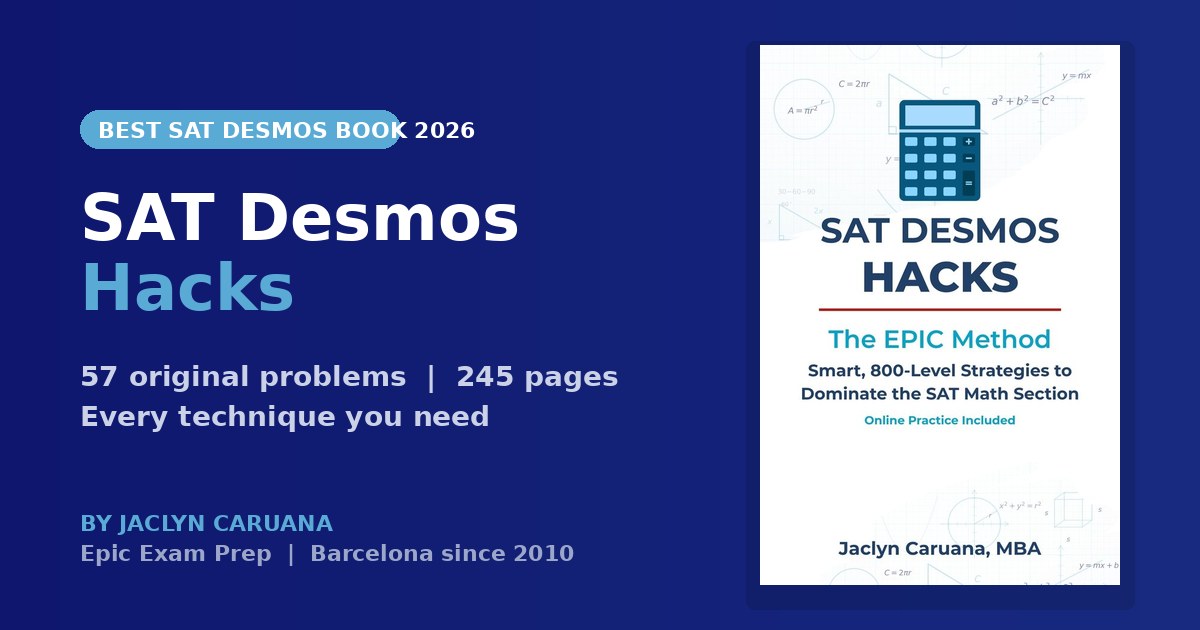
SAT Desmos Hacks by Jaclyn Caruana covers all five techniques above with 57 original SAT-style problems and step-by-step Desmos solutions.
Includes online practice access at desmos.prepdrills.com
Get the Kindle: US$9.99 → Paperback: US$34.99Curriculum-Specific Notes
JC (A-Level) students: H2 Mathematics uses the Casio fx-CG50 or TI-84 as the approved graphing calculator. Desmos overlaps heavily with these tools but has a faster interface for intersection finding, regression, and inequality shading. The main adjustment is learning to type equations directly rather than navigating menus. JC students already have strong algebra, so the Desmos transition is primarily about speed, not comprehension.
IB Diploma students: IB Math Analysis and Approaches (AA) and Applications and Interpretation (AI) both use a GDC extensively. IB students taking the SAT will find Desmos familiar in concept but different in interface. The tilde for regression, the slider for parameters, and the one-click intersection are Desmos-specific. IB students typically need 2 to 3 practice sessions to become fluent in the differences.
IGCSE students: IGCSE Additional Mathematics provides strong algebraic foundations but limited graphing calculator exposure. These students benefit the most from dedicated Desmos practice because the tool is genuinely new to them. The five techniques above represent capabilities they have not used before, not just faster versions of existing workflows.
American curriculum students at Singapore American School, Stamford American International School, and similar institutions typically have some Desmos exposure from US-aligned math courses. Students at international schools in Japan (ASIJ, Nishimachi) face a similar curriculum context; see our Japan-specific Desmos hacks guide for that audience. Their gap is usually technique-specific: they know Desmos exists but have not practiced the five SAT-optimized techniques systematically.
Test Center Realities in Singapore
The Digital SAT is administered at approved test centers throughout Singapore, including Singapore American School, UWCSEA Dover and East campuses, Stamford American International School, Global Indian International School (GIIS), and institute-based centers like MDIS and LLI. The Bluebook application runs on school-provided devices at all centers, and the built-in Desmos calculator is available on every Math question regardless of which center you test at. For full details on test dates, registration deadlines, fees, and center-specific logistics, see our complete SAT in Singapore 2026 guide. Use our Digital SAT score calculator to estimate your score from practice test results.
The Book: SAT Desmos Hacks
SAT Desmos Hacks: The EPIC Method for Smart, Fast, 800-Level Math by Jaclyn Caruana is a dedicated SAT math workbook built entirely around the Desmos graphing calculator, paired with a companion practice site at desmos.prepdrills.com. It covers all five techniques above with 57 original SAT-style problems across all four Math domains (Algebra, Advanced Math, Problem Solving and Data Analysis, Geometry and Trigonometry). Every problem includes a step-by-step Desmos solution with screenshots showing exactly what to type and what the graph looks like. The EPIC Method framework (Engage, Pinpoint, Interpret, Choose) gives you a repeatable decision process for every question.
Get the Book
Available worldwide. Singapore students can order the Kindle edition for immediate access or the paperback with international shipping.
Also available on amazon.sg (approximately S$49.63 paperback). Kindle edition delivers instantly worldwide.
If you are preparing for an upcoming SAT date, pair the book with the Desmos cheat sheet for a printable one-page reference during practice sessions. Singapore students targeting European universities like Bocconi will find that the same Desmos techniques apply to their SAT Math preparation regardless of whether the target school is in the US or Europe.