This SAT vocabulary list has 100 words that have already appeared in official College Board questions, as the right answer, as a trap, or both. Each word comes with its part of speech, pronunciation, definition and an example sentence, all from the book SAT Vocabulary Voyage.
- 42 Academic words of argument and evidence (concede, mitigate, contingent).
- 26 Second meaning words, common words in a test meaning (compound = make worse).
- 22 Rare words that show up in harder questions, often as wrong choices.
- 10 Plain words you need to read fast and cross out wrong answers.
Study them in sentences, sort them into Know, Kind of know and Don’t know, and review the last two piles first. Jump to the full list.
How these 100 SAT words were chosen
SAT Vocabulary Voyage teaches 1,000 words, chosen from the vocabulary College Board uses in its questions: as right answers, as wrong choices and in passages. The book flags 420 of them as already seen on the official SAT: 393 that appeared in official College Board questions and 27 more that appeared in official SAT passages.
All 100 words on this page come from the 393 that appeared in official questions. We picked a spread across 27 of the book’s 33 Seas and all four labels, weighted toward the Academic and Second meaning words that decide the most points.
What the labels mean
Not every word deserves the same attention. Each card carries one of four labels from the book, plus a tag that shows how the word has appeared on the official SAT.
The words of argument and evidence, such as concede, mitigate and contingent on. The core of the harder module. 411 of the book’s 1,000 words.
A common word in a meaning you may not know, such as check meaning “hold back.” The test loves these. 85 in the book.
Less common words that appear in harder questions, often as wrong choices. 450 in the book.
A common word in its everyday meaning. You need it to read fast and to cross out wrong choices. 54 in the book.
The role tag says how the word has appeared in official College Board vocabulary questions: On the SAT: answer as the right answer, On the SAT: trap as a wrong choice, or On the SAT: answer and trap as each in different questions. Pronunciation is written in syllables, with the stressed syllable in capitals: uh-NOM-uh-lee.
Why trap words matter as much as answers
A third of the words on this list appeared on the SAT only as wrong choices. They earn their place because a Words in Context question is a four-way decision. If you know three of the four choices, you can cross out the wrong ones and reach the answer even when it is a word you have never seen. If you do not know the trap words, a sensible-sounding wrong choice stays alive and costs you time, or the point.
The traps also follow patterns. Some are the Flip: the word that would be right on the other side of a but or without a not. Others are Close Cousins such as forestall next to mitigate: one prevents a problem, the other only lessens it. Our guide to SAT Words in Context questions names all six trap types and shows them in worked examples.
How to study this list: Know, Kind of know, Don’t know
The routine comes from the book and works for any word list:
- Read the card aloud. Say the word with its pronunciation, then read the example sentence aloud. On the test you meet words inside sentences, so learn them that way.
- Sort every word into one of three piles in a notebook:
- Start each session with yesterday’s Kind of know and Don’t know piles, then add a new group of words. The book does this one Sea of 30 words a day, with a review Harbor every five days.
- Test the words in questions. Knowing a definition is not the same as picking the word under time pressure. Practice with the method in our Words in Context practice set, then with College Board’s official questions in Bluebook.
The SAT vocabulary list: 100 words already seen on the official SAT
Grouped by label, alphabetical within each group. Jump to a group, or use the A to Z index to find a word.
Academic words (42)
Academic The words of argument and evidence, such as concede, mitigate and contingent on. The core of the harder module.
ambiguity
am-bih-GYOO-ih-teenounthe quality of having more than one possible meaning
Because of an ambiguity in the lease, “monthly” could mean each calendar month or every thirty days, and the two parties disagreed.
Day 5, Sea of Influence
ambivalent
am-BIV-uh-luntadjectivehaving mixed or conflicting feelings about something
She felt ambivalent about moving to a new city, excited yet nervous at the same time.
Day 21, Sea of Emotions
analogous
uh-NAL-uh-gusadjectivesimilar in a way that allows a useful comparison
The wings of bats and butterflies are analogous structures: they serve the same function of flight, yet they evolved entirely separately.
Day 1, Sea of Paradox
anomaly
uh-NOM-uh-leenounsomething that differs from what is normal or expected
The researchers first dismissed the white-furred mouse as an anomaly, a rare departure from the brown coats seen in every other litter.
Day 1, Sea of Paradox
complementary
kom-pluh-MEN-tuh-reeadjectivedifferent but completing each other, so that together they work better
The duo’s talents were complementary: the composer wrote soaring melodies, while the lyricist supplied the sharp, witty words he lacked.
Day 2, Sea of Humanity
concede
kun-SEEDverbto admit something is true after denial or resistance
After seeing the new data, the senator conceded that her earlier estimate had been too optimistic.
Day 7, Sea of Society
conjecture
kun-JEK-chernounan opinion or guess formed without full evidence
For over three centuries, Fermat’s claim remained a mere conjecture, since no mathematician could supply the proof needed to confirm it.
Day 1, Sea of Paradox
contingent
kun-TIN-juntadjectivedependent on certain conditions
The museum’s expansion is contingent on a government grant; if the funding does not arrive, construction cannot begin.
Day 9, Sea of Fracture
discrepancy between
dis-KREP-un-see betweennoun phrasea difference between two things that should match
Auditors flagged a discrepancy between the warehouse’s recorded inventory and the boxes actually on its shelves, suggesting that goods had gone missing.
Day 9, Sea of Fracture
disseminate
dih-SEM-uh-naytverbto spread widely
Health workers disseminated the warnings through radio, posters, and village meetings so that every household would hear them.
Day 14, Sea of Conflict
dormant
DOR-muntadjectivetemporarily inactive but able to become active again
The volcano had been dormant for centuries, so villagers farmed its slopes, unaware that magma was slowly gathering beneath them.
Day 6, Sea of Earth
elicit
ih-LIS-itverbto draw out a response, reaction, or piece of information
By asking open questions instead of yes-or-no ones, the interviewers managed to elicit detailed memories from even the shyest participants.
Day 5, Sea of Influence
elusive
ee-LOO-sivadjectivedifficult to find, catch, or understand
A cure remained elusive for decades, slipping away each time researchers believed they were close.
Day 11, Sea of Identity
empirical
im-PEER-ih-kuladjectivebased on observation or experience
The theory stayed popular until empirical studies, based on measurements from hundreds of actual farms, showed that yields did not rise as predicted.
Day 15, Sea of Discovery
feasible
FEE-zuh-buladjectivepossible to do or achieve in practice
Engineers judged the tunnel feasible only after tests showed the rock was solid enough to bore through without collapsing.
Day 4, Sea of Ambition
hallmark
HAWL-marknouna typical feature that clearly identifies something
Rapid, improvised solos became the hallmark of bebop, so recognizable that listeners could identify the style within a few bars.
Day 17, Sea of Artistry
homogeneous
hoh-muh-JEEN-yusadjectiveuniform in composition; similar throughout
The sample was too homogeneous to reveal differences, since every participant was a twenty-year-old student from the same town.
Day 2, Sea of Humanity
implement
IM-pluh-mentverbto put a plan, policy, or decision into effect
Although the council approved the recycling plan in spring, it took two more years to implement it across every neighborhood.
Day 23, Sea of Power
implicit
im-PLIS-itadjectivesuggested or understood without being directly stated
In many villages the rules of hospitality are implicit; no one writes them down, yet every guest knows to refuse the first offer of food.
Day 5, Sea of Influence
incompatible
in-kum-PAT-uh-buladjectiveunable to exist or work together without conflict
Darwin recognized that his theory was incompatible with the belief that every species had remained fixed and unchanged since its creation.
Day 33, Deep Sea VII
integral
IN-tuh-gruladjectiveessential and necessary to make something complete
Railroads were integral to the growth of Chicago; without them, the city could never have become the nation’s central market for grain.
Day 6, Sea of Earth
latent
LAY-tuntadjectivepresent but not yet visible
Her musical talent remained latent until a teacher offered her a violin, and within a year she was performing in public.
Day 10, Sea of Confluence
mediated by
MEE-dee-ay-tid byverb phrasebrought about or carried out through something in between
In many plants, bending toward light is mediated by auxin, a hormone that makes cells on the shaded side of the stem grow longer.
Day 2, Sea of Humanity
misconstrue
mis-kun-STROOverbto understand something wrongly
Early readers misconstrued the satire as a serious proposal, not realizing the author was mocking cruel policies.
Day 26, Sea of Precision
mitigate
MIT-ih-gaytverbto make something less severe, harmful, or painful
Planting mangroves along the coast can mitigate storm damage, since their dense roots absorb much of the force of incoming waves.
Day 3, Sea of Obstruction
negligible
NEG-lih-juh-buladjectiveso small or unimportant that it can be ignored
Because air resistance on the small steel ball was negligible, the students could ignore it when calculating the fall time.
Day 1, Sea of Paradox
nuance
NOO-ahnsnouna subtle difference in meaning or expression
A skilled translator captures every nuance of a poem, conveying not just its literal meaning but the subtle shades of tone beneath it.
Day 11, Sea of Identity
pragmatic
prag-MAT-ikadjectivedealing with things realistically and practically
Instead of waiting for a perfect treaty, the pragmatic negotiators accepted a partial deal that would at least reopen the border to trade.
Day 15, Sea of Discovery
propensity
pruh-PEN-suh-teenouna natural tendency to behave in a certain way
Economists note people’s propensity to overvalue what they own; sellers often demand more for a mug than they would pay for one.
Day 2, Sea of Humanity
proponent of
pruh-POH-nunt ofnoun phrasea person who argues for or supports an idea or plan
A leading proponent of public libraries, the reformer argued that free access to books would strengthen democracy by educating ordinary workers.
Day 24, Sea of Evidence
protracted
proh-TRAK-tidadjectivelasting longer than expected or than usual
The protracted lawsuit dragged on for eleven years, long after most observers had expected the two companies to reach a quick settlement.
Day 12, Sea of Resilience
prudent
PROO-duntadjectivewise and careful, especially about future risks
The merchant made the prudent choice to spread her goods across five ships, so that a single shipwreck could never ruin her.
Day 19, Sea of Ideals
refute
rih-FYOOTverbto prove a statement or theory wrong
Pasteur’s swan-neck flask experiments refuted the idea of spontaneous generation by showing that no microbes grew when airborne dust was kept out.
Day 1, Sea of Paradox
resilient
rih-ZIL-yuntadjectiveable to recover quickly from difficulty
Some grassland ecosystems are remarkably resilient, recovering within a few seasons after a fire that seemed to have destroyed them completely.
Day 8, Sea of Transformation
rudimentary
roo-duh-MEN-tuh-reeadjectivebasic and undeveloped; at an early stage
The earliest computers had only rudimentary memory, storing a tiny fraction of the data that an ordinary modern laptop can hold.
Day 16, Sea of Frontiers
susceptible to
suh-SEP-tuh-bul toadjective phraseeasily affected, influenced, or harmed by something
Because every banana plant on the plantation was a genetic clone, the whole crop was susceptible to the same fungus, which spread unchecked.
Day 6, Sea of Earth
tenuous
TEN-yoo-usadjectivevery weak or slight
The link between the two events is tenuous, resting on a single letter whose date historians still dispute.
Day 11, Sea of Identity
transcend
tran-SENDverbto go beyond the usual limits of something
Rumi’s poems, written in Persian in the thirteenth century, have transcended their original time and place, finding devoted readers across many cultures.
Day 4, Sea of Ambition
ubiquitous
yoo-BIK-wuh-tusadjectivepresent everywhere
Plastic has become ubiquitous, found in deep ocean trenches, Arctic sea ice, and even the snow near the summit of Everest.
Day 8, Sea of Transformation
undermine
un-der-MYNverbto weaken gradually or secretly
Repeated errors in the report gradually undermined the agency’s credibility, weakening public trust in its later findings.
Day 7, Sea of Society
underscore
UN-der-skorverbto emphasize
Each new measurement of rising seas underscores the report’s warning, making it ever harder to dismiss as exaggeration.
Day 3, Sea of Obstruction
untenable
un-TEN-uh-buladjectivenot able to be defended logically
With three independent studies contradicting it, the claim became untenable, and even its author withdrew it.
Day 7, Sea of Society
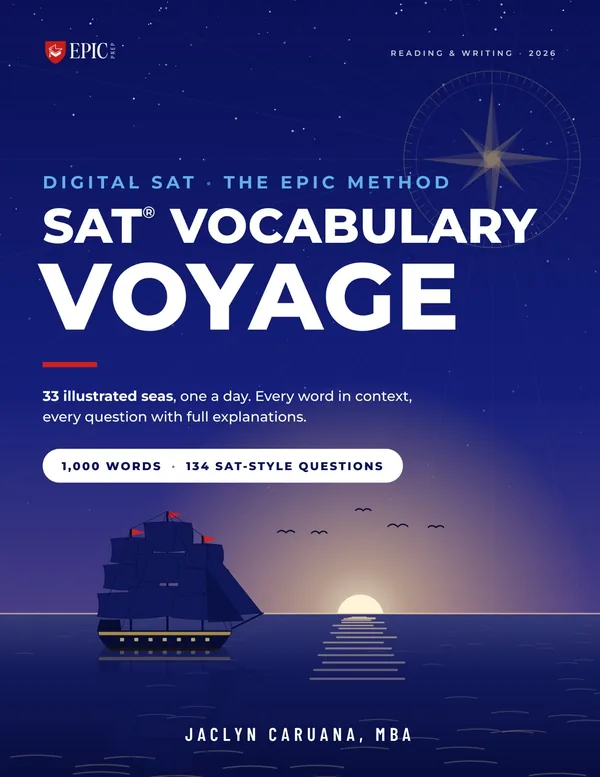
These 100 are a sample. The book has all 1,000.
SAT Vocabulary Voyage teaches 1,000 Digital SAT words in context over 33 daily Seas, flags the 420 already seen on the official SAT, and tests them with 134 SAT-style questions, every wrong choice explained. Paperback, 314 pages, ISBN 979-8165621376.
The same Seas are in Vocabulary Voyage in the PrepDrills app, with audio, flashcards and quizzes. The app runs with Epic Exam Prep students now; its public launch is January 2027. See inside the book
Second meaning words (26)
Second meaning A common word in a meaning you may not know, such as check meaning “hold back.” The test loves these.
acquire
uh-KWYRverbto come to have a quality, meaning, or reputation
Everyday meaning: to buy or get possession of
Over centuries the English word nice, which once meant foolish, gradually acquired its present meaning of pleasant and kind.
Day 8, Sea of Transformation
command
kuh-MANDverbto deserve and receive something, such as respect or attention
Everyday meaning: to give an order
The young violinist commanded the audience’s full attention; even the restless children in the front row sat perfectly still.
Day 4, Sea of Ambition
compound
kom-POUNDverbto make a problem or difficulty worse
Everyday meaning: a mixture of two or more parts
Bad weather delayed the shipment, and a strike at the port compounded the company’s losses, pushing the store’s opening back by months.
Day 12, Sea of Resilience
consideration
kun-sid-uh-RAY-shunnouna factor, such as cost or gain, that is weighed when deciding
Everyday meaning: kindness toward other people’s feelings
For the shipping company, cost was the overriding consideration; it chose the slower route because fuel savings outweighed any loss of time.
Day 4, Sea of Ambition
consistent with
kun-SIS-tunt withphrase (adjective)in agreement with; fitting something without contradicting it
Everyday meaning: always behaving or performing the same way
The bite marks on the bones are consistent with an attack by a large cat, though they do not rule out other predators.
Day 1, Sea of Paradox
contract
kun-TRAKTverbto catch or develop an illness
Everyday meaning: to make an agreement, or to shrink
Explorers who drank from the stagnant pools often contracted fever, while those who boiled their water first stayed healthy.
Day 6, Sea of Earth
derivative
dih-RIV-uh-tivadjectivecopied from others’ work; lacking originality
Everyday meaning: in math, a rate of change
Critics dismissed the novel as derivative, noting that its plot borrowed heavily from earlier detective stories without adding a single new twist.
Day 17, Sea of Artistry
dictate
DIK-taytverbto control or decide something with authority
Everyday meaning: to say words aloud for someone to write
In ancient Egypt, the Nile’s yearly flood dictated the farming calendar, since crops could be planted only after the waters had receded.
Day 23, Sea of Power
discount
DIS-kountverbto dismiss something as unimportant or unreliable
Everyday meaning: lower the price of something
Early researchers discounted the idea that birds navigate by sensing magnetic fields, until experiments with European robins in the 1960s proved it correct.
Day 13, Sea of Logic
exhaustive
ig-ZAW-stivadjectivecomplete and thorough, covering every part or possibility
Everyday meaning: often mistaken for exhausting, meaning very tiring
The historian’s exhaustive survey of the colonial archives examined every surviving ledger, leaving no record of the port’s trade unread.
Day 15, Sea of Discovery
exploit
ik-SPLOYTverbto make full, productive use of a resource or advantage
Everyday meaning: to use someone unfairly for gain
Early mill owners learned to exploit the river’s steady current, turning its force into power for looms and saws.
Day 16, Sea of Frontiers
foster
FOS-terverbto encourage the growth or development of something
Everyday meaning: care for a child who is not yours
Community gardens can foster trust among neighbors, since working side by side gives strangers a reason to talk and cooperate.
Day 2, Sea of Humanity
fruitful
FROOT-fuladjectiveproducing good results
Everyday meaning: producing a lot of fruit
The partnership proved fruitful, producing three new medicines in the decade after the two labs began working together.
Day 10, Sea of Confluence
inertia
ih-NER-shuhnouna tendency to resist change and keep doing the same thing
Everyday meaning: in physics, resistance to changes in motion
Bureaucratic inertia kept the outdated rule in place for decades, even after nearly every official agreed it should be repealed.
Day 3, Sea of Obstruction
institute
IN-stuh-tootverbto establish or set up a rule, system, or practice
Everyday meaning: a research or education organization
After several workers were injured, the factory owners instituted new safety rules, requiring helmets and regular inspections of every machine.
Day 18, Sea of Justice
manifest
MAN-uh-festadjectiveclearly visible or obvious; (manifest in) plainly shown in
Everyday meaning: to wish a goal into reality by believing
Though she never spoke of her grief, it was manifest in the untouched garden she had once tended every morning.
Day 11, Sea of Identity
modest
MOD-istadjectivefairly small or limited in size, amount, or extent
Everyday meaning: not boastful about one’s achievements
Despite the minister’s grand promises, the reform produced only a modest rise in wages, barely two percent over five years.
Day 6, Sea of Earth
novel
NAH-vuladjectivenew and original, unlike anything seen before
Everyday meaning: a long fictional book
The engineer’s novel approach to bridge design, using woven bamboo instead of steel, surprised judges who had never seen anything similar.
Day 16, Sea of Frontiers
proxy
PROK-seenounsomething used as a stand-in or indirect measure for another thing (proxy for)
Everyday meaning: a person allowed to vote for another
Because no thermometers existed in ancient times, scientists use tree rings as a proxy for past temperatures.
Day 3, Sea of Obstruction
realize
REE-uh-lyzverbto achieve or make real, such as a goal or plan
Everyday meaning: to suddenly understand or become aware
The architect never realized her design for a floating library; funding collapsed, and the plans sat in a drawer for fifty years.
Day 4, Sea of Ambition
reflect
rih-FLEKTverbto show or be a sign of something
Everyday meaning: to throw back light or an image
The steady rise in bicycle sales reflects a growing public concern about air pollution and traffic in crowded cities.
Day 11, Sea of Identity
reserve
ri-ZURVnouna habit of holding back one’s feelings; emotional restraint
Everyday meaning: something saved for later use
Known for her reserve, the physicist rarely discussed her own work, yet her letters reveal intense excitement about each discovery.
Day 21, Sea of Emotions
singular
SING-gyuh-leradjectiveremarkable; unusual in a striking way
Everyday meaning: referring to just one, not plural
The critic praised the photographer’s singular vision, noting that no one else had captured city streets with such strange, dreamlike stillness.
Day 2, Sea of Humanity
sway
SWAYnounpower to influence or control
Everyday meaning: a gentle side-to-side movement
For nearly a century the merchant guilds held great sway over the city, deciding who could trade and who could govern.
Day 5, Sea of Influence
transparent
trans-PAIR-untadjectiveopen and honest, with nothing hidden
Everyday meaning: see-through, letting light pass
To rebuild public trust, the city council made its budget process transparent, posting every expense online for residents to review.
Day 25, Sea of Nuance
yield
YEELDverbto produce or provide a result or amount
Everyday meaning: to give way, as to traffic
The excavation yielded thousands of pottery fragments, which helped archaeologists date each layer of the settlement.
Day 26, Sea of Precision
Rare words (22)
Rare Less common words that appear in harder questions, often as wrong choices.
abate
uh-BAYTverbto become less strong or intense; to die down
Public anger over the new tax did not abate; instead, protests grew larger each week until the governor withdrew the law.
Day 6, Sea of Earth
ameliorate
uh-MEEL-yuh-raytverbto make something better or improve
Planting trees along city streets can ameliorate summer heat, making neighborhoods noticeably cooler and more comfortable for residents.
Day 8, Sea of Transformation
arcane
ar-KAYNadjectiveknown or understood by very few people; obscure
The medieval guild guarded its arcane dyeing methods so closely that only three masters in each generation learned the full recipe.
Day 2, Sea of Humanity
belie
bih-LYverbto give a false impression of; to hide the true nature of
The scholar’s gentle, soft-spoken manner belied a fierce intellect that left her opponents stunned during debates.
Day 1, Sea of Paradox
buttress
BUT-risverbto support or strengthen
New data from twelve hospitals buttressed the case for the vaccine, adding weight to the earlier findings.
Day 7, Sea of Society
clandestine
klan-DES-tinadjectivedone in secret, often because it is illegal or forbidden
Along the Underground Railroad, clandestine networks of homes and guides helped enslaved people travel north at night, hidden from slave catchers.
Day 33, Deep Sea VII
conflate
kun-FLAYTverbto combine two ideas incorrectly into one
Students often conflate weather and climate, treating a single cold day as if it disproved a long-term warming trend.
Day 7, Sea of Society
corroborate
kuh-ROB-uh-raytverbto confirm or support with evidence
A second witness, who had never spoken to the first, corroborated her account by describing the same blue car at the same corner.
Day 15, Sea of Discovery
dogmatic
dog-MAT-ikadjectiveasserting opinions as unquestionably true
The dogmatic professor dismissed every new finding that contradicted his theory, insisting that the matter was already settled.
Day 1, Sea of Paradox
engender
en-JEN-derverbto cause or give rise to a feeling or situation
The factory’s sudden closing engendered deep distrust between residents and the town council, a resentment that lasted for decades.
Day 8, Sea of Transformation
eschew
es-CHOOverbto deliberately avoid or keep away from
Minimalist composers such as Steve Reich eschewed the dense harmonies of their predecessors, building whole works from short, steadily repeated patterns.
Day 33, Deep Sea VII
forestall
for-STAWLverbto prevent or obstruct something by taking action in advance
To forestall a shortage, the city began storing extra water months before the dry season, acting early to prevent the crisis.
Day 3, Sea of Obstruction
incongruous
in-KONG-groo-usadjectivenot in harmony or keeping with surroundings
A neon sign looked incongruous on the medieval stone chapel, clashing sharply with the quiet, ancient character of the village square.
Day 11, Sea of Identity
multifaceted
mul-tee-FAS-ih-tidadjectivehaving many different sides, parts, or aspects
Paul Robeson led a multifaceted life: he was a star athlete, a trained lawyer, a concert singer, an actor, and an activist.
Day 2, Sea of Humanity
paucity of
PAW-suh-tee ofphrase (noun)a lack of something; too small an amount
The paucity of fossils from that period frustrates paleontologists, who must reconstruct entire ecosystems from a handful of bones.
Day 4, Sea of Ambition
repudiate
rih-PYOO-dee-aytverbto reject something completely as untrue or unacceptable
Late in life, the former senator repudiated the segregationist views he had once championed, apologizing publicly for the harm they had caused.
Day 13, Sea of Logic
sanguine
SANG-gwinadjectiveoptimistic or confident, especially in a difficult situation
Despite the poor early results, the lead researcher remained sanguine, confident that the next round of trials would succeed.
Day 21, Sea of Emotions
spurious
SPYOOR-ee-usadjectivenot genuine or true
The so-called ancient map proved spurious; its ink contained a chemical not invented until the twentieth century.
Day 19, Sea of Ideals
succinct
suk-SINGKTadjectivebrief and clearly expressed, using few words
Rather than reading her forty-page report aloud, the senator gave a succinct summary of three sentences that everyone in the chamber understood.
Day 5, Sea of Influence
supersede
soo-pur-SEEDverbto replace or take the place of
The new edition of the dictionary superseded the old one, replacing outdated entries with definitions that reflected modern usage.
Day 20, Sea of Innovation
unassuming
un-uh-SOO-mingadjectivemodest and not trying to attract attention
Despite winning the Nobel Prize, the unassuming chemist rode her bicycle to the lab each morning and rarely mentioned the award.
Day 22, Sea of Legends
unequivocal
un-ih-KWIV-uh-kuladjectiveclear and certain, leaving no doubt
The results of the long study were unequivocal: every group that quit smoking showed a clear drop in heart disease.
Day 5, Sea of Influence
Plain words (10)
Plain A common word in its everyday meaning. You need it to read fast and to cross out wrong choices.
abrupt
uh-BRUPTadjectivesudden and unexpected
The pianist’s abrupt departure surprised everyone, as she stood up in the middle of the concert and left without warning.
Day 9, Sea of Fracture
aesthetic
es-THET-ikadjectiveconcerned with beauty or artistic taste
The architect cared about aesthetic as much as practical concerns, choosing materials for their beauty as well as their strength.
Day 19, Sea of Ideals
catastrophic
kat-uh-STROF-ikadjectiveinvolving great damage or disaster
The failure of the dam was catastrophic, flooding entire towns and destroying farmland across the valley in a single night.
Day 9, Sea of Fracture
collaboration
kuh-lab-uh-RAY-shunnounworking jointly with others
The vaccine was a collaboration among labs in four countries, each contributing a different part of the research.
Day 10, Sea of Confluence
commonplace
KOM-un-playsadjectiveordinary and found everywhere; not unusual
Electric lighting, a marvel at the 1881 Paris exhibition, became commonplace in city homes within a few decades.
Day 25, Sea of Nuance
consensus
kun-SEN-susnoungeneral agreement
After months of debate, the scientists reached a consensus, with nearly all agreeing that the fossil belonged to a new species.
Day 9, Sea of Fracture
innovative
IN-uh-vay-tivadjectiveintroducing new ideas or methods
Rather than repeating older designs, the engineer’s innovative bridge used woven bamboo cables, a method no one had tested at that scale.
Day 15, Sea of Discovery
overlook
oh-ver-LOOKverbto fail to notice or give proper attention to something
Early surveys of the reef overlooked the tiny shrimp entirely, since divers hunting for large fish rarely examined the narrow crevices in the coral.
Day 3, Sea of Obstruction
skeptical
SKEP-tih-kuladjectivenot easily convinced; doubting
Many astronomers were skeptical of the claim, noting that a single blurry photograph was not enough to prove a new planet existed.
Day 11, Sea of Identity
supplement
SUP-luh-mentverbto add to complete or enhance
Many farmers supplement their income by renting rooms to tourists during the summer harvest festival.
Day 10, Sea of Confluence
Second meanings the SAT loves
These ten words look easy, which is the problem. Each one has an everyday meaning that most students know and a second meaning that the test uses. On a fill-in-the-blank question the second meaning is often the answer; on an underlined-word question the everyday meaning is often the trap.
| Word | Everyday meaning | Meaning on the test |
|---|---|---|
| consistent with | always behaving or performing the same way | in agreement with; fitting something without contradicting it |
| foster | care for a child who is not yours | to encourage the growth or development of something |
| proxy | a person allowed to vote for another | something used as a stand-in or indirect measure for another thing (proxy for) |
| inertia | in physics, resistance to changes in motion | a tendency to resist change and keep doing the same thing |
| sway | a gentle side-to-side movement | power to influence or control |
| modest | not boastful about one’s achievements | fairly small or limited in size, amount, or extent |
| compound | a mixture of two or more parts | to make a problem or difficulty worse |
| discount | lower the price of something | to dismiss something as unimportant or unreliable |
| yield | to give way, as to traffic | to produce or provide a result or amount |
| reflect | to throw back light or an image | to show or be a sign of something |
The book gives these words their own label and ends with a Sea of Double Meanings: eight underlined-word questions on public-domain excerpts from authors such as Brontë, Dickens, Twain and Shakespeare. One is worked through step by step in our Words in Context guide.
False friends for Spanish, Italian and French speakers
A false friend is an English word that looks like a word in your language but means something else. They are dangerous on the SAT because they feel familiar, so you stop reading carefully. The book adds a False friend note to the cards where the trap is real; here are eleven of them, including several from this list.
| English word | Language | The false friend | English meaning on the test |
|---|---|---|---|
| consistent with | Italian | consistente means solid or firm | in agreement with; fitting something without contradicting it |
| inconsequential | Spanish | inconsecuente means inconsistent or illogical, not unimportant | unimportant; too small to matter |
| rationalize | Spanish | racionalizar means make rational or organize work efficiently, not make excuses | to justify behavior with reasons that sound logical but may be false |
| suppress | French | supprimer means delete, remove, or abolish | to hold back or keep something from developing or being expressed |
| abate | Spanish | abatir means to knock down or shoot down (abatido means dejected) | to become less strong or intense; to die down |
| susceptible to | French | susceptible on its own means touchy, easily offended | easily affected, influenced, or harmed by something |
| facile | French, Italian | facile usually just means easy | too simple; ignoring how complex an issue really is |
| novel | Spanish | novel means a beginner or inexperienced (un escritor novel) | new and original, unlike anything seen before |
| amend | French | une amende is a fine (a penalty payment), not a correction | to change something, such as a law or text, to improve or correct it |
| fabricate | Spanish | fabricar and it: fabbricare mean to manufacture, with no sense of lying | to invent false information in order to deceive |
| conform to | Spanish | conformarse (con) means to settle for or make do with, not to follow a rule | to follow or match a rule, pattern, or expectation |
One note works the other way: Spanish realizar means to carry out, which matches the test meaning of realize (to achieve or make real, such as a goal or plan), so Spanish speakers have an advantage there. The book’s False friend notes cover Spanish, Italian and French speakers; it has none for German.
What to do after this list
- Learn the method. Vocabulary gives you the meanings; the method tells you which one the text proves. Start with SAT Words in Context: how to answer every question.
- Check the terms. The SAT glossary for international students explains modules, adaptive scoring and the other words College Board uses about the test.
- See where you stand. After a Bluebook practice test, convert your raw scores with the Digital SAT score calculator.
- Cover the rest of the section. Vocabulary is one part of Reading and Writing. For grammar, transitions and evidence questions, see Epic Exam Prep’s SAT English guide.
- Balance it with Math. Our companion book SAT Desmos Hacks covers the Desmos calculator for the Math section.
Get all 1,000 words: SAT Vocabulary Voyage
The full voyage: 26 core Seas and 7 Deep Seas of word cards, each with similar words, word family and Don’t confuse notes; daily exercises; 134 SAT-style questions with every wrong choice explained; the Sea of Double Meanings; and a 27-question Final Crossing. By Jaclyn Caruana, MBA, co-founder of Epic Exam Prep.
The same Seas are in Vocabulary Voyage in the PrepDrills app, with audio, flashcards and quizzes. The app runs with Epic Exam Prep students now; its public launch is January 2027. See inside the book
Frequently asked questions
What vocabulary is on the Digital SAT?
Vocabulary is tested most directly in Words in Context questions, part of the Craft and Structure domain of the Reading and Writing section. College Board says these questions focus on high-utility academic words: words such as mitigate, concede or contingent on that appear across subjects in college reading, often in a precise or less familiar meaning. Rarer words appear mainly as wrong choices in harder questions.
Where do the 100 words on this list come from?
They are a sample from SAT Vocabulary Voyage, a 1,000-word Digital SAT vocabulary book by Jaclyn Caruana. The book flags 420 of its words as already seen on the official SAT: 393 that appeared in official College Board questions as the right answer, as a wrong choice, or both, and 27 more that appeared in official SAT passages. All 100 words here come from the 393 that appeared in official questions.
What does On the SAT as a trap mean?
It means the word has appeared in official College Board vocabulary questions as a wrong answer choice. On the SAT as an answer means it was the right answer, and answer and trap means it has been each in different questions. Trap words matter because you have to know a word to cross it out with confidence.
How many SAT vocabulary words should I learn?
There is no official list, so aim for words you can use, not a number. SAT Vocabulary Voyage teaches 1,000: 780 in 26 core Seas of 30 words, plus 220 rarer words in seven Deep Seas for students aiming above 750 in Reading and Writing. If you have little time, start with the words flagged as already seen on the SAT, like the 100 on this page.
What is the fastest way to learn SAT vocabulary?
Learn words inside sentences, a small set at a time, and review on a schedule. Read each word with its pronunciation and example sentence aloud, mark it Know, Kind of know or Don't know, and start the next session by reviewing the words you marked Kind of know and Don't know. Then test yourself with SAT-style questions, because recognizing a word and choosing it under time pressure are different skills.
Are very rare words like lassitude on the Digital SAT?
Not as the focus of vocabulary questions. College Board's Assessment Framework for the Digital SAT Suite names lassitude, supercilious and adumbrate as words too rare to be tested profitably in Words in Context questions. That is why lists built on obscure words waste time. Learn high-utility academic words and second meanings first, and treat rare words as wrong choices to recognize.
Do second meanings matter on the SAT?
Yes. Many Words in Context questions use a common word in a less familiar meaning, such as compound meaning make worse or discount meaning dismiss as unimportant. On underlined-word questions, expect at least two wrong choices to be real meanings of the word, so you must decide which meaning the sentence uses, not which meaning you know best.
Is there a printable version of this SAT vocabulary list?
Yes. Use your browser's print command (Ctrl+P, or Cmd+P on a Mac) and choose Save as PDF; the book promotions are left out of the printout. The full list of 1,000 words, with similar words, word families, Don't confuse notes and practice questions, is in SAT Vocabulary Voyage, in paperback and Kindle.