A Words in Context question gives you a short text with one word missing or underlined and four choices. Answer it in four steps:
- Cover the choices and read the whole text first.
- Hunt the clue. The proof usually comes after the blank: a colon, a second sentence, “for example” or “that is.”
- Read the water. Decide positive or negative, more or less, and settle any pivot (but, although) or negation (not, hardly) first.
- Call, then match. Say your own plain word, keep the one choice that means it, and point to the proof.
Most wrong choices fall into six traps: Flip, Doesn’t Fit, Close Cousin, Wrong Strength, Never Said and Wrong Sense. Below: the method in depth, five worked examples and a practice set with full explanations.
What Words in Context questions are on the Digital SAT
The Reading and Writing section of the Digital SAT has 54 questions in two 32-minute modules, 64 minutes in all, and the second module is harder or easier depending on how you did in the first (College Board: How the SAT Is Structured). Every question is built on a short passage of 25 to 150 words, or a pair of passages, drawn from literature, history and social studies, the humanities and science (College Board: The Reading and Writing Section).
College Board sorts those questions into four content domains. Words in Context belongs to Craft and Structure, together with Text Structure and Purpose and Cross-Text Connections. In College Board’s words, the domain measures the skills “needed to understand and use high-utility words and phrases in context” (College Board: What Are Content Domains?).
How many there are, and where they sit
- About 28% of the section. Craft and Structure accounts for about 28% of the scored Reading and Writing questions (College Board: Reading and Writing Specifications), which the Assessment Framework for the Digital SAT Suite (version 4, September 2026) puts at 13 to 15 questions. Words in Context shares that total with the other two Craft and Structure skills; College Board does not publish a separate count for it.
- At the front of each module. The framework sets the domain order inside every Reading and Writing module: Craft and Structure first, then Information and Ideas, Standard English Conventions and Expression of Ideas. Within the domain, questions are ordered by skill and then from easiest to hardest. So the vocabulary questions come as a group near the start of Module 1 and again near the start of Module 2.
- Two ways of asking. The framework’s sample questions use two question stems. The fill-in-the-blank stem reads “Which choice completes the text with the most logical and precise word or phrase?” The underlined-word stem, used with literary excerpts, reads “As used in the text, what does the word ‘___’ most nearly mean?”
Which words get tested
The framework says Words in Context questions focus on “high-utility academic, or tier two, words”: words that appear across subjects in college reading. It also names lassitude, supercilious and adumbrate as words rare enough that they are “not the focus” of these questions. Two practical consequences follow:
- The right answer is usually a word educated readers meet often (mitigate, concede, contingent on), but often in a precise or less familiar meaning.
- Rarer words still show up, mostly as wrong choices in the harder module. You have to know a word to cross it out.
That is why the method below matters as much as the word list. Knowing words gives you the meanings; the method shows you which meaning the text proves, and that is what earns the point. If you want the words themselves, start with our SAT vocabulary list of 100 words already seen on the official SAT.
The four-step method for Words in Context
SAT Vocabulary Voyage teaches this method before Day 1, and every explanation in the book uses its language. The four steps take about as long to do as to read, and they work on both question formats.
Cover the choices
Hide the four choices with your hand or your scratch paper and read the whole text first. Students who read the choices first start trying words on, and the wrong ones always fit a little. Test writers choose wrong answers that sound natural next to the blank; the only defense is to form your own idea of the answer before you see theirs.
Read to the end of the text, not just to the blank. The sentence with the blank is rarely the sentence that proves the answer.
Hunt the clue
Keep reading past the blank. The proof usually comes after it, in a colon, a second sentence, “for example” or “that is.” A clue is a group of words that says the same thing as the missing word, or the opposite of it. In the book’s first worked example, Borobudur is “: long rows of carved stone reliefs cover the walls of its terraces.” Everything after the colon describes decoration, so the blank must mean highly decorated (the answer is ornate).
If you cannot find a clue, you have not finished reading. Every Words in Context text contains the evidence for its answer, because the question asks for the most logical word, and logic needs evidence.
Read the water
Before you steer, decide whether the blank needs a positive or a negative word, more or less of something. Then settle any pivot (but, although, rather than) or negation (not, hardly, by no means, far from) first, because each one flips the word you need. The signal words fall into four groups:
Same direction
The clue and the blank point the same way, so your word should repeat the clue’s idea, often a little more strongly after “in fact” or “indeed.”
Opposite direction
The blank sits on one side of the pivot and the clue on the other. Name what the other side says, then flip it. A word that fits the other side is the Flip.
Cause and result
State the cause in plain words, then ask what must follow from it. The blank names the cause or the result, never something unrelated.
Example or restatement
What comes after these words is a ready-made definition of the blank. Sum up the examples in one word, or copy the restatement in your own words.
Negations need surgery. When the blank sits after not, hardly, by no means or far from, work out what the whole phrase must say, then remove the negation. In the book’s hardest worked example, a lake’s microbial life was “by no means ” and the samples held nearly 4,000 different kinds of bacteria and archaea. The phrase must still say varied, so the blank itself means all one kind: homogeneous. The tempting choice, heterogeneous, matches the evidence, which is exactly why it is wrong.
“Not merely” pushes the strength up. When a text says someone “did not merely question” something, the blank must be stronger than questioning. Practice question 3 below turns on this.
Call, then match
Say your own plain word, even a clumsy one such as “not real” or “very dry.” Then uncover the choices, keep only the one that means your word, and point to the clue that proves it.
Your called word does not need to be elegant or even appear among the choices. Its job is to be a fixed target, so the choices have to come to you rather than the other way round. If two choices both seem to match, your call was too vague: go back to the clue and make it more exact (how much? in which direction? about what?).
The six traps in Words in Context answer choices
Wrong choices on the Digital SAT are not random. Each one is built to catch a specific mistake, and every explanation in SAT Vocabulary Voyage names the trap behind every wrong choice. Learn the names and you will start to see them before you fall into them.
A word that points the wrong way, often the word that would be right on the other side of a pivot or without the negation. In “Although the crowd was huge, the applause was ,” the word “thunderous” is the Flip.
A topic word that the subject cannot do or be, so ask “Can a ___ do that?” A city cannot be “studious”; its students can.
A near-synonym that misses the one detail the clue insists on. Indifference and reserve can both describe an unsmiling face, but if the text says the people “did not lack feeling,” only reserve fits.
The right idea, one rung too weak or too strong. If “no bacteria grew there at all,” the bacteria were “destroyed,” not just “weakened.”
A choice that makes a sensible sentence about the topic, but no words in the text prove it. Old trading cities were often “wealthy,” yet if the text only describes scholars and students, you cannot point to proof.
For an underlined word, a real meaning of that word that this sentence does not use. In “He fixed his gaze on the sunshade,” “fixed” means focused, not “repaired.”
The EPIC rules
- Predict a plain word first, then keep only the choice that means it.
- A rare word earns no points for being rare, so never choose a word for its sound or its length.
- A word you don’t know can be right. If the words you know don’t fit the clue, choose the one you don’t know, but never just because it is unfamiliar.
- Point to the proof. If you cannot underline the words that prove a choice, it is not the answer.
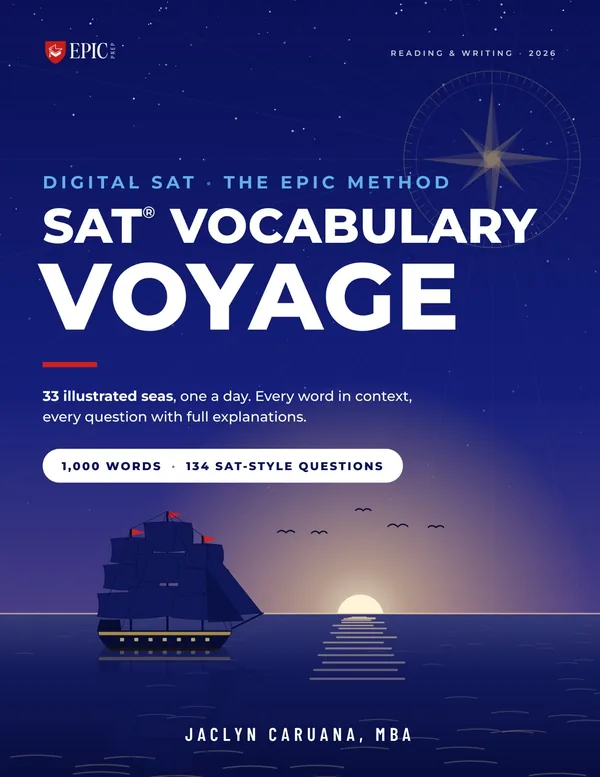
Learn the words the method needs: SAT Vocabulary Voyage
1,000 Digital SAT words taught in context over 33 daily Seas, with 134 SAT-style questions and an explanation for every answer choice. 420 words are flagged as already seen on the official SAT. Paperback, 314 pages, published October 27, 2026.
The same Seas are in Vocabulary Voyage in the PrepDrills app, with audio, flashcards and quizzes. The app runs with Epic Exam Prep students now; its public launch is January 2027. See inside the book
Five worked examples from the book
Each example below is copied from SAT Vocabulary Voyage, with the book’s explanation for every choice. The “How to solve it” lines walk through the four steps. Try each question before you read the solution.
For centuries, many European naturalists believed that eels arose from river mud, since no one had ever found eel eggs in local streams. Researchers in the early twentieth century, tracing ever smaller young eels across the Atlantic to the Sargasso Sea, helped that belief, concluding instead that the fish hatch far out in the ocean.
Which choice completes the text with the most logical and precise word or phrase?
- A) validate
- B) qualify
- C) rationalize
- D) refute
- Clue
- “concluding instead that the fish hatch far out in the ocean.”
- Water
- “Instead” is a pivot: the old belief was replaced, not adjusted. Direction: against the belief.
- Call
- “prove wrong.”
- Match
- refute means to prove wrong. Note the trap in B: qualify has the right direction but is a rung too weak.
- FlipA) validate. To validate the belief would be to confirm it, but the research showed that eels hatch at sea instead of arising from mud.
- Wrong StrengthB) qualify. To qualify a belief is only to limit it, but “concluding instead” means the belief was replaced entirely, not adjusted.
- Doesn’t FitC) rationalize. To rationalize is to justify something with convenient reasons, but the researchers overturned the belief rather than defending it.
- CorrectD) refute. Choice D is the best answer. The word “instead” signals that the research replaced the old belief with a different explanation. To show a belief is wrong is to refute it.
In 1802 the French engineer Albert Mathieu-Favier proposed a tunnel beneath the English Channel, lit by oil lamps and traveled by horse-drawn coaches, but his plan was not . No one of his time had machines capable of boring through miles of rock under the seabed, and a tunnel did not open until 1994.
Which choice completes the text with the most logical and precise word or phrase?
- A) profitable
- B) impractical
- C) feasible
- D) ambitious
- Clue
- “No one of his time had machines capable of boring through miles of rock.”
- Water
- The blank follows not. Do the surgery: “not ___” must mean impossible to build then, so the blank itself means possible.
- Call
- “doable.”
- Match
- feasible means possible to carry out. Impractical is the Flip that the negation creates.
- Close CousinA) profitable. Profitable concerns making money, but the text explains the failure by missing machinery, not cost or earnings.
- FlipB) impractical. Saying the plan was “not impractical” would mean it could be carried out, which contradicts the missing machinery.
- CorrectC) feasible. Choice C is the best answer. The negation “not” pairs with the reason that no one had machines able to bore the tunnel. A plan that cannot be carried out with the tools available is not feasible.
- Never SaidD) ambitious. The text gives no sign that the plan lacked ambition; a tunnel lit by lamps and traveled by coaches is, if anything, very ambitious.
The economist argued that the popular explanation for the city’s housing shortage, that builders were simply greedy, was : it ignored zoning rules, rising construction costs, and population growth, each of which researchers had linked to the shortage.
Which choice completes the text with the most logical and precise word or phrase?
- A) exhaustive
- B) redundant
- C) provocative
- D) facile
- Clue
- After the colon: the explanation “ignored zoning rules, rising construction costs, and population growth.”
- Water
- Negative: the economist is criticizing the explanation.
- Call
- “too simple.”
- Match
- facile means too simple, ignoring the real complexity. Exhaustive is the Flip: an explanation that ignored three causes is the opposite of complete.
- FlipA) exhaustive. An exhaustive explanation covers every factor, but this one ignored three of them.
- Doesn’t FitB) redundant. Redundant means repeating something already stated, but the economist’s complaint is that the explanation left causes out, not that it repeated them.
- Never SaidC) provocative. The text does not say the explanation stirred strong reactions; it says the explanation left out key causes.
- CorrectD) facile. Choice D is the best answer. The colon explains that the explanation left out several known causes. An explanation that ignores how complex an issue is is facile.
Early portrait photographs often show sitters with stiff, unsmiling faces. Long exposure times made holding a smile difficult, but historians point to custom as well. Many sitters did not lack feeling; rather, they regarded open displays of emotion in a formal portrait as improper and so deliberately adopted an air of .
Which choice completes the text with the most logical and precise word or phrase?
- A) exuberance
- B) trepidation
- C) indifference
- D) reserve
- Clue
- “did not lack feeling; rather, they regarded open displays of emotion … as improper.”
- Water
- The sitters had feelings but held them back on purpose. The blank names the manner they chose, not an absence of feeling.
- Call
- “holding feelings back.”
- Match
- reserve means emotional restraint. Indifference is the Close Cousin: it means lacking feeling, which the text explicitly denies.
- FlipA) exuberance. Exuberance is energetic joy, the opposite of the restrained, unsmiling manner the text describes.
- Never SaidB) trepidation. Trepidation is fear about what may happen, but the text never says the sitters were afraid; it says they held back emotion out of custom.
- Close CousinC) indifference. Indifference means lacking feeling or concern, but the text states that the sitters did not lack feeling; they chose not to show it.
- CorrectD) reserve. Choice D is the best answer. The sitters had feelings but considered showing them improper and deliberately held them back, which is reserve, or emotional restraint.
The following text is from Mark Twain’s 1883 memoir Life on the Mississippi. The narrator recalls his boyhood in a small Missouri town on the Mississippi River, where the daily arrival of steamboats, or packets, was the great event.
Once a day a cheap, gaudy packet arrived upward from St. Louis, and another downward from Keokuk. Before these events, the day was glorious with expectancy; after them, the day was a dead and empty thing. Not only the boys, but the whole village, felt this.
As used in the text, what does the word “dead” most nearly mean?
- A) defunct
- B) dull
- C) exact
- D) eventful
- Clue
- The day before the boats is “glorious with expectancy”; after them it is “a dead and empty thing.”
- Water
- Negative, set against “glorious with expectancy.” Cover the underlined word and read the sentence without it.
- Call
- “boring, with nothing left to happen.”
- Match
- dull. Two other choices, defunct and exact, are real meanings of “dead,” which is why “it can mean that” is never proof.
- Wrong SenseA) defunct. Although “dead” can mean defunct, no longer working, as in a dead battery, the day did not stop existing. It simply had nothing exciting left in it.
- CorrectB) dull. Choice B is the best answer. The text sets the hours before the boats arrive, “glorious with expectancy,” against the hours after them, a “dead and empty thing” that “the whole village” felt. A day with all the excitement gone is dull, so “dead” means dull.
- Wrong SenseC) exact. Although “dead” can mean exact, as in “dead center,” the text is not measuring anything. It is describing how the day felt.
- FlipD) eventful. “Eventful” describes the time before the boats came, when the day was “glorious with expectancy.” After they left, the day was “empty,” the opposite of eventful.
Notice the pattern in example 5. On underlined-word questions, expect at least two wrong choices to be real dictionary meanings of the word. The book collects these questions in its Sea of Double Meanings, built on public-domain excerpts from authors such as Brontë, Dickens, Twain and Shakespeare. Our SAT vocabulary list has a short section on the second meanings the test likes most.
Practice set: five more questions from the book
Use the full method on each one: cover, hunt, read the water, call, match. Then open the answer and check which trap each wrong choice was. The set climbs from Day 1 to the Deep Seas.
No written records survive from the people who built many of Britain’s Neolithic stone circles. Archaeologists can therefore offer only about the ceremonies once held at these sites, although careful study of how the stones line up with the rising and setting sun has narrowed the range of possibilities.
Which choice completes the text with the most logical and precise word or phrase?
- A) conjecture
- B) analogy
- C) approximation
- D) certainty
Show the answer and explanation
Answer: A) conjecture
- CorrectA) conjecture. Choice A is the best answer. Because no written records survive, scholars can only make educated guesses about the ceremonies. A guess formed without full evidence is conjecture.
- Doesn’t FitB) analogy. An analogy is a comparison between two things, and the text never says archaeologists compare the ceremonies to anything.
- Close CousinC) approximation. An approximation is a near estimate of a quantity, but the text concerns guesses about the nature of ceremonies, not a measured amount.
- FlipD) certainty. Certainty would require firm evidence, but the text says no written records survive and the evidence only narrows the possibilities.
For more than a century, search parties combed the Canadian Arctic for the two ships of the lost 1845 Franklin expedition, but efforts to find the vessels themselves were . The wrecks were not located until underwater surveys found one in 2014 and the other in 2016.
Which choice completes the text with the most logical and precise word or phrase?
- A) fruitful
- B) fruitless
- C) haphazard
- D) modest
Show the answer and explanation
Answer: B) fruitless
- FlipA) fruitful. Fruitful efforts would have succeeded, but neither wreck was found until the twenty-first century.
- CorrectB) fruitless. Choice B is the best answer. The wrecks were not found until 2014 and 2016, so the earlier searches for the vessels failed. Efforts that produce no result are fruitless.
- Never SaidC) haphazard. Haphazard describes disorganized methods, and the text says nothing about how the searches were planned, only that they failed.
- Wrong StrengthD) modest. Modest suggests small but real success, yet the text says the earlier searches never located the wrecks.
When the debut novel appeared, several prominent reviewers did not merely question its plot or its pacing; they it in print, calling the book careless, derivative, and an insult to the intelligence of its readers.
Which choice completes the text with the most logical and precise word or phrase?
- A) eulogized
- B) critiqued
- C) excoriated
- D) commandeered
Show the answer and explanation
Answer: C) excoriated
- FlipA) eulogized. Eulogized means praised highly, the opposite of calling the book careless and derivative.
- Wrong StrengthB) critiqued. Critiqued is too mild; the phrase “did not merely question” signals that the reviewers went well beyond ordinary criticism.
- CorrectC) excoriated. Choice C is the best answer. The words “did not merely question” and the harsh labels that follow show severe criticism, which is what excoriated means.
- Doesn’t FitD) commandeered. Commandeered means took control of something by force, which does not describe a reviewer’s response to a book.
Coastal wetlands normally absorb some of the force of storm surges. When developers drain these marshes to build homes, they not only destroy habitat but also the flooding risk, since the next storm meets no natural buffer before it reaches the new houses.
Which choice completes the text with the most logical and precise word or phrase?
- A) attenuate
- B) sustain
- C) reveal
- D) compound
Show the answer and explanation
Answer: D) compound
- FlipA) attenuate. To attenuate is to weaken, but the text says the buffer is gone, so the risk grows.
- Wrong StrengthB) sustain. This word means keep at the same level, but losing the buffer increases the risk.
- Never SaidC) reveal. The text is about the risk becoming greater, not about a hidden risk being exposed.
- CorrectD) compound. Choice D is the best answer. Removing the buffer means storms hit the houses with more force, so draining the marshes makes an existing risk worse. To compound a problem is to make it worse.
The following text is from Booker T. Washington’s 1901 autobiography Up from Slavery. After the Civil War, Washington, then a boy, moved with his family to West Virginia.
The opening of the school in the Kanawha Valley, however, brought to me one of the keenest disappointments that I ever experienced. I had been working in a salt-furnace for several months, and my stepfather had discovered that I had a financial value, and so, when the school opened, he decided that he could not spare me from my work. This decision seemed to cloud my every ambition. The disappointment was made all the more severe by reason of the fact that my place of work was where I could see the happy children passing to and from school mornings and afternoons.
As used in the text, what does the word “spare” most nearly mean?
- A) protect
- B) release
- C) reserve
- D) pardon
Show the answer and explanation
Answer: B) release
- Wrong SenseA) protect. Although “spare” can mean protect someone from something unpleasant, as in “spare me the details,” the stepfather is not trying to shield the boy from work. He has found that the boy has “a financial value,” so he wants him to keep working.
- CorrectB) release. Choice B is the best answer. The stepfather has “discovered that I had a financial value,” so when the school opens he will not let the boy leave the salt-furnace, and the boy has to watch other children walk to school. To spare someone from work in this sense is to let the person go, so “spare” means release.
- Wrong SenseC) reserve. Although “spare” can describe something held in reserve, as in a spare tire, the stepfather is not setting the boy aside for later. He wants the boy’s wages now.
- Wrong SenseD) pardon. Although “spare” can mean pardon, as in sparing a prisoner, nobody in the text has done anything wrong or is facing punishment.
How to build the vocabulary behind the method
The method decides between choices; vocabulary tells you what the choices mean. You need both. A plan that works:
- Learn words in sentences, not lists of synonyms. The test never shows a word alone. Read each word’s example sentence aloud, then make your own.
- Learn the trap words too. A word that appears as a wrong choice still costs you time if you have to guess what it means.
- Sort, then review. Mark every word Know, Kind of know or Don’t know, and start the next session with the last two piles. Our SAT vocabulary list explains the routine.
- Practice the method on real items. Use College Board’s Bluebook practice tests and Student Question Bank for official questions, and keep a log of which trap caught you.
Words in Context is one of ten skills College Board lists for Reading and Writing. For the full section, including grammar, transitions and evidence questions, see Epic Exam Prep’s SAT English guide. To check what a practice result means for your score, try the Digital SAT score calculator, and if a test term is unfamiliar, the SAT glossary for international students defines it. For the Math section, our companion book SAT Desmos Hacks does for the graphing calculator what this method does for vocabulary.
SAT Vocabulary Voyage: 1,000 words, one Sea a day
Each day: 30 word cards with pronunciation, definition and example sentence, a Captain’s Log of exercises and a three-question SAT Check. Then the Sea of Double Meanings and a 27-question Final Crossing. 134 SAT-style questions, every wrong choice explained by name. By Jaclyn Caruana, MBA, with 15+ years of teaching.
The same Seas are in Vocabulary Voyage in the PrepDrills app, with audio, flashcards and quizzes. The app runs with Epic Exam Prep students now; its public launch is January 2027. See inside the book
Frequently asked questions
What are Words in Context questions on the SAT?
Words in Context questions are a Reading and Writing question type on the Digital SAT. Each one gives you a short text with one word or phrase missing, or one word underlined, and four answer choices. You choose the word that completes the text with the most logical and precise meaning, or you say what the underlined word most nearly means as used in the text. College Board places the skill in the Craft and Structure domain.
How many Words in Context questions are on the Digital SAT?
College Board does not publish a separate count for Words in Context. Its Assessment Framework for the Digital SAT Suite says the Craft and Structure domain makes up about 28% of the scored Reading and Writing questions, 13 to 15 questions, and that domain also includes Text Structure and Purpose and Cross-Text Connections. Words in Context is one of the three skills sharing that total.
What is the best strategy for SAT Words in Context questions?
Use four steps. Cover the choices and read the whole text first. Hunt the clue, which usually comes after the blank, in a colon, a second sentence, or a phrase such as for example or that is. Read the water: decide whether the blank needs a positive or negative word and settle any pivot or negation. Then call your own plain word, uncover the choices, keep only the one that means your word, and point to the clue that proves it.
What are the most common wrong-answer traps in Words in Context?
SAT Vocabulary Voyage names six. Flip points the wrong way. Doesn't Fit is a word the subject cannot do or be. Close Cousin is a near-synonym that misses the detail the clue insists on. Wrong Strength has the right idea but is one rung too weak or too strong. Never Said makes a sensible sentence that no words in the text prove. Wrong Sense, for underlined words, is a real meaning of the word that this sentence does not use.
Do I need to memorize hard SAT words?
Not obscure ones. College Board says Words in Context questions focus on high-utility academic words, and its framework names lassitude, supercilious and adumbrate as words too rare to be tested profitably. Rarer words still appear as wrong choices in harder questions, so you need to know enough of them to cross them out. Learn words inside sentences and practice the method alongside the vocabulary.
How long should I spend on a Words in Context question?
The Reading and Writing section gives you 64 minutes for 54 questions, which College Board puts at about 1 minute and 11 seconds per question. Words in Context texts are short, so with the four-step method most students can answer them in under a minute and bank time for the longer evidence and inference questions later in the module.
What should I do if I don't know any of the answer choices?
Predict your own plain word first, then cross out every choice you know that does not match it. A word you don't know can be right: if none of the words you know fit the clue, choose the one you don't know. Never choose a word only because it is unfamiliar, rare or long, and never choose one you cannot prove with words in the text.
Are the example questions on this page real SAT questions?
No. The examples and practice questions come from SAT Vocabulary Voyage by Jaclyn Caruana. They are original questions written in the style of the Digital SAT, with explanations that name the trap behind every wrong choice. For official questions, use the full-length practice tests in College Board's Bluebook app and the Student Question Bank.